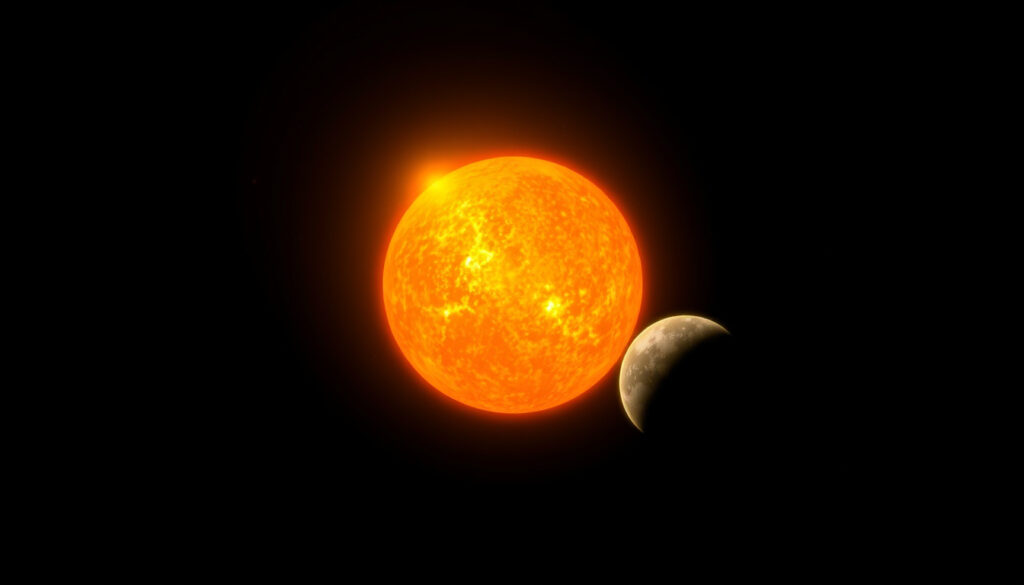
How Old Is the Sun? Age, Lifespan, and Comparison to Earth
Few numbers in science feel as humbling as the age of the Sun. Astronomers have pinned it at 4.6 billion years — an age derived not from the Sun itself, but from meteorites that formed alongside it. In this article, we’ll walk through how scientists arrived at that number, how the Sun compares to Earth and the Moon, and what its future holds for life on our planet.
Age of the Sun: 4.6 billion years ·
Formation: 4.6 billion years ago ·
Remaining lifespan: ~5 billion years ·
Main composition: 73% hydrogen, 25% helium ·
Current stage: Main sequence (yellow dwarf)
Quick snapshot
- Sun is 4.6 billion years old (NASA Space Place (NASA’s educational arm))
- Sun will become a red giant in about 5 billion years (The Planetary Society (space advocacy nonprofit))
- Sun is composed mostly of hydrogen and helium (Britannica (authoritative reference))
- Exact age of the Sun is known to ±0.1 billion years — the margin comes from different meteorite dating techniques (Arizona State University News (university research))
- Precise impact of the Moon’s absence on life evolution is speculative (Planetary Science Institute (research institute))
- Sun formed 4.6 billion years ago from a molecular cloud (NASA Space Place)
- In ~5 billion years, hydrogen will run out, triggering red giant phase (The Planetary Society)
- Earth becomes uninhabitable in ~1 billion years due to increasing solar luminosity (USGS Geologic Time (government agency))
- Sun will end as a white dwarf, not a black hole (Britannica)
Six key measurements, one pattern: the ages of the Sun, Earth, and Moon cluster tightly around 4.5–4.6 billion years, reinforcing that they all formed in a brief cosmic window.
| Fact | Value |
|---|---|
| Sun’s age (billion years) | 4.6 |
| Sun’s mass (kg) | 1.989 × 10³⁰ |
| Sun’s diameter (km) | 1,391,000 |
| Earth’s age (billion years) | 4.54 |
| Moon’s age (billion years) | 4.51 |
| Time until Sun becomes red giant (billion years) | ~5 |
How Old Is the Sun?
The Sun is 4.6 billion years old. That number comes from radiometric dating of meteorites — the oldest solids in the Solar System. Scientists cannot sample the Sun directly, but they can date material that coalesced from the same solar nebula. The NASA Space Place (NASA’s education portal) explains that by measuring the age of the oldest meteorites, researchers infer the Sun formed around the same time.
How do scientists determine the Sun’s age?
- The most precise method is radiometric dating, which measures the decay of radioactive isotopes (e.g., uranium-lead, rubidium-strontium) in meteorites (U.S. National Park Service (geology resource)).
- By dating the oldest Solar System rocks — iron meteorites like Canyon Diablo — scientists get an age of 4.54–4.58 billion years (USGS Geologic Time (official U.S. geological survey)).
- The age of the Sun is consistent with the age of the Milky Way and the universe as estimated in the early 20th century (USGS).
What is the exact age of the Sun in years?
- High-precision dating of ureilite meteorites gives 4.5639 billion years, with an uncertainty of about 0.00045 billion years (Planetary Science Institute (meteorite research)).
- A 2010 study from Arizona State University revised the Solar System age to 4.5682 billion years, about 0.3–1.9 million years older than previous estimates (Arizona State University News (university press)).
- That means the Sun is between 4.563 and 4.568 billion years old, depending on which meteorite class you use as the clock.
Is Earth older than the Sun?
No — the Sun is slightly older than Earth, but both formed within a few million years of each other from the same molecular cloud. The Planetary Society (space advocacy organization) states Earth is about 4.54 billion years old, while the Sun is about 4.6 billion. That makes the Sun about 60 million years older.
How does the Earth’s age compare to the Sun’s?
- Earth’s age (4.54 Ga) is based on lead-isotope ratios in the Canyon Diablo meteorite (USGS).
- The Moon is 4.51 billion years old, formed shortly after Earth from a giant impact (NASA Space Place).
- The entire Solar System started forming about 4.6 billion years ago (The Planetary Society).
The implication: Earth, the Moon, and the Sun are cosmic siblings with nearly identical birth dates, differing by only tens of millions of years.
How long will our Sun last?
The Sun has about 5 billion years of main-sequence life remaining. During this phase, it fuses hydrogen into helium in its core. Once that fuel runs out, dramatic changes begin.
What happens when the Sun runs out of fuel?
- In about 5 billion years, the Sun will exhaust its core hydrogen and expand into a red giant, engulfing Mercury and Venus (The Planetary Society).
- Earth’s orbit will likely change, but the planet will be scorched and uninhabitable long before that (USGS).
- After the red giant phase, the Sun will shed its outer layers, leaving a white dwarf — a dense, cooling remnant (Britannica).
Will the Sun become a black hole?
No. Only stars with more than about 20 times the Sun’s mass can collapse into black holes. The Sun’s mass is far too low. It will end as a white dwarf, not a black hole (Britannica).
“The Sun formed approximately 4.6 billion years ago from the gravitational collapse of matter.” — The Planetary Society
How many years are left for life on Earth?
Earth will become uninhabitable for complex life much sooner than the Sun’s death. The Sun’s luminosity increases by about 1% every 100 million years, gradually raising Earth’s surface temperature.
What will happen to Earth in 1 billion years?
- In roughly 1 billion years, the Sun’s increased brightness will boil away Earth’s oceans, making the planet a dry, Venus-like world (USGS Geologic Time).
- Complex life (plants, animals) will likely disappear much earlier, perhaps in 500–800 million years, as carbon dioxide levels drop and photosynthesis becomes impossible.
- Microbial life might survive longer, but the window for a habitable Earth is limited to about 1 billion years from now.
Will Earth survive until 3000?
Yes, absolutely. The year 3000 is only 1,000 years away — a blink in geological time. Earth will remain fully habitable for many millions of years to come. The only threats on that timescale are human-caused, not astronomical.
What would Earth be like if there were no Moon?
The Moon plays a critical role in stabilizing Earth’s axial tilt and driving tides. Without it, conditions would be very different.
Could we survive without a moon?
- Earth’s axial tilt would vary chaotically, causing extreme climate swings — from ice ages to hothouse periods — that could stress life (Planetary Science Institute).
- Tides would be only about one-third as strong, driven by the Sun alone. This would affect ocean currents and marine ecosystems.
- Life might still exist, but the evolution of complex organisms could have been slower or different.
How does the Moon affect Earth’s tilt and tides?
- The Moon’s gravitational pull keeps Earth’s obliquity (tilt) stable at about 23.5°, preventing wild swings (NASA Space Place).
- Without the Moon, tilt could vary from 0° to 85°, making seasons extremely erratic.
- The Moon also causes the tides, which have shaped coastal life and possibly the first life on Earth.
“The precise impact of the Moon’s absence on life evolution is speculative.” — Planetary Science Institute
What is 98% of the Sun made of?
The Sun is a giant ball of plasma, mostly hydrogen and helium. The often-cited “98%” refers to the combined mass of these two elements.
Could life exist on the Sun?
No. The Sun’s surface temperature is about 5,500°C (10,000°F), and the core reaches 15 million°C. No known life form can survive those conditions. The Sun is a fusion furnace, not a habitat.
What elements make up the remaining 2%?
- Oxygen, carbon, neon, iron, nitrogen, silicon, magnesium, and sulfur make up the rest (Britannica).
- These heavier elements were forged in earlier generations of stars and became part of the solar nebula.
- Despite being only 2% by mass, they include all the elements necessary for rocky planets and life.
reddit.com, pubs.usgs.gov, reddit.com, en.wikipedia.org, pubs.usgs.gov
Scientists refined the Sun’s age of 4.6 billion years using solar age dating methods, which also help calibrate the ages of other stars in the galaxy.
Frequently Asked Questions
How old is the Sun exactly?
The Sun is 4.6 billion years old, give or take 0.1 billion years. The precise age from meteorite dating is between 4.563 and 4.568 billion years, depending on the sample.
Is the Sun older than Earth?
Yes, the Sun is about 60 million years older than Earth. Earth formed 4.54 billion years ago, while the Sun formed 4.6 billion years ago.
How long will the Sun continue to shine?
The Sun has about 5 billion years of stable hydrogen fusion left. After that, it will become a red giant and then a white dwarf, still shining faintly for billions more years.
What will happen to Earth when the Sun dies?
Earth will become uninhabitable in about 1 billion years due to increasing solar luminosity. When the Sun becomes a red giant, Earth will likely be engulfed or scorched to a cinder.
What is the Sun made of?
The Sun is about 73% hydrogen, 25% helium, and 2% other elements (oxygen, carbon, neon, iron, etc.).
Could life exist anywhere near the Sun?
No. The Sun’s surface temperature is extreme and its atmosphere is a turbulent plasma. Life as we know it cannot exist there.
Why does the Moon’s age matter for Earth?
The Moon’s age (4.51 billion years) helps confirm the timeline of the Solar System’s formation and its giant-impact origin, which set Earth’s tilt and tides.
For more on the Moon’s appearance, see Why Is the Moon Orange Tonight? Science, Myths & 2026 Events. And for the story behind a classic song, read You Are My Sunshine: Real Meaning & Origin Story.
More related posts
 Chlamydia Bumps on Tongue: Symptoms, Causes, and Treatment
 King of the Hill New Season: Season 15 Confirmed & Release Date
 Obituary Kelly McGillis 2018 – Actress Still Alive
 What Season Are We In? Current Season Dates for UK & USA
 DogDay Poppy Playtime: Character Guide, Lore, and Fate
 Six Flags St Louis – Hours, Tickets, Rides and Guide
 Tudor Black Bay 58 Review: Worth It? Price & Value Retention