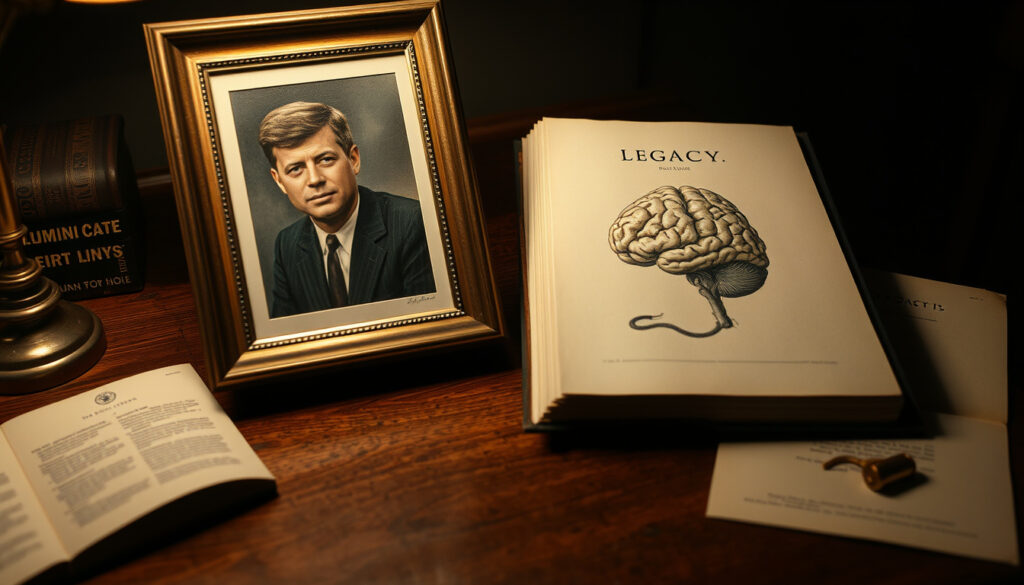
Robert F. Kennedy: Assassination, Legacy & RFK Jr.’s Brain Worm
The Kennedy family has long been a fixture in American politics, but two events — the 1968 assassination of Robert F. Kennedy and his son’s 2024 revelation of a parasitic brain worm — have linked father and son in an unexpected way. This article traces the assassination, the health scare, and the political legacy that binds them.
Date of assassination: June 6, 1968 · Age at death: 42 · Number of children: 11 · Number of bullets that struck RFK: 3 · Year RFK Jr. revealed brain worm: 2024
Quick snapshot
- RFK assassinated on June 6, 1968 after winning California primary (Encyclopaedia Britannica (historical reference))
- Sirhan Sirhan convicted of murder (Encyclopaedia Britannica)
- RFK Jr. had a dead parasitic worm in his brain (CBS News (network investigative reporting))
- Exact number of shots that hit RFK varies; three is widely reported (History.com (historical archive))
- Long-term cognitive effects of RFK Jr.’s brain worm are not fully documented (University of California, Riverside (academic medicine commentary))
- Assassination occurred June 5, 1968; death June 6 (History.com)
- RFK Jr. announced brain worm in May 2024 (UC Riverside)
- RFK Jr. continues independent presidential campaign (CBS News)
- Debate over cognitive fitness for office likely to persist (UC Riverside)
Six key facts about Robert F. Kennedy Sr. — one pattern: they paint a picture of a man who rose fast, served close to power, and died young.
| Label | Value |
|---|---|
| Full name | Robert Francis Kennedy |
| Born | November 20, 1925 |
| Died | June 6, 1968 |
| Spouse | Ethel Skakel Kennedy |
| Children | 11 (including RFK Jr.) |
| Notable roles | U.S. Attorney General, U.S. Senator (NY) |
Why was Robert F. Kennedy assassinated?
Robert F. Kennedy was shot on June 5, 1968, at the Ambassador Hotel in Los Angeles, moments after winning the California Democratic presidential primary. He died the next day. The motive, the shooter, and the political context remain subjects of intense scrutiny.
Who shot Robert F. Kennedy?
- Sirhan Sirhan, a 24-year-old Palestinian-Jordanian immigrant, fired multiple shots at Kennedy. He was convicted of murder in 1969 and sentenced to death, later commuted to life in prison after California briefly abolished the death penalty (Encyclopaedia Britannica (criminal justice record)).
How many times was he shot?
- Kennedy was struck by three bullets. One entered his head, one went through his back, and a third passed through his clothing without hitting him (History.com (historical documentation)). Another source notes that a fourth shot hit a bystander (Encyclopaedia Britannica).
What was Sirhan Sirhan’s motive?
- Sirhan said he shot Kennedy because of Kennedy’s support for Israel during the 1968 campaign. In court, he stated, “I killed him for my country” (Encyclopaedia Britannica (trial testimony)).
The implication: the assassination continues to fuel debate about political violence in America.
How did RFK Jr. get the brain worm?
In May 2024, during his presidential campaign, Robert F. Kennedy Jr. disclosed that doctors had found a dead parasitic worm in his brain more than a decade earlier. The revelation sparked intense media coverage and questions about his health.
What is a parasitic brain worm?
- The condition is neurocysticercosis, caused by the larval stage of the pork tapeworm Taenia solium. When the parasite dies, the immune system can cause inflammation, leading to seizures and other neurological symptoms (University of California, Riverside (infectious disease analysis)).
How do people get Taenia solium?
- Humans get infected by eating undercooked pork containing cysts of the tapeworm. RFK Jr. said his infection likely came from eating undercooked pork during travel (CBS News (interview transcript)).
What kills brain worms?
- Treatment involves antiparasitic drugs such as albendazole or praziquantel, often combined with corticosteroids to reduce inflammation (UC Riverside (medical guidelines)).
The catch: despite medical treatment, the long-term effects remain undocumented, adding uncertainty to his candidacy.
What was Robert F. Kennedy famous for?
Robert F. Kennedy built a reputation as a tough prosecutor, a civil rights advocate, and a symbol of a new kind of politics. His fame rests on three roles.
What was RFK’s role as Attorney General?
- He served as U.S. Attorney General from 1961 to 1964 under his brother President John F. Kennedy. He was a key advisor during the Cuban Missile Crisis and pushed for civil rights legislation (Encyclopaedia Britannica (government service record)).
How did he serve as a U.S. Senator?
- Elected from New York in 1964, he served until his death in 1968. In the Senate, he focused on poverty, racial justice, and antiwar issues (History.com (congressional biography)).
What were his major achievements?
- Beyond office, Kennedy became a moral voice for the Democratic Party, advocating for the poor and marginalized. His 1968 campaign centered on ending the Vietnam War and healing racial divides (Encyclopaedia Britannica (political legacy)).
Kennedy’s brief Senate career and tragically cut-short campaign created a mythic figure — the “what if” of American politics. For the Democratic Party, his death meant the loss of a leader who could unite the warring factions of 1968.
The pattern: his assassination cemented a legacy that his policies alone might not have achieved.
How is Robert Kennedy Jr related to JFK?
RFK Jr. is the son of Robert F. Kennedy and Ethel Kennedy, making him the nephew of President John F. Kennedy and cousin to John F. Kennedy Jr.
Who are the parents of RFK Jr.?
- His father is Robert F. Kennedy, and his mother is Ethel Skakel Kennedy. He was born on January 17, 1954 (Encyclopaedia Britannica (family tree documentation)).
What is the Kennedy family tree?
- The Kennedy political dynasty includes Joseph P. Kennedy Sr., President John F. Kennedy, Senator Robert F. Kennedy, Senator Edward M. Kennedy, and their descendants. RFK Jr. is one of 11 children and the eldest son (Encyclopaedia Britannica (genealogy)).
The implication: RFK Jr.’s campaign is the latest chapter in a family history that mixes privilege, tragedy, and ambition. The family name carries weight — and baggage.
How did Robert F. Kennedy’s assassination impact American politics?
The assassination of Robert F. Kennedy sent shockwaves through a nation already reeling from the murder of Martin Luther King Jr. two months earlier. It changed the course of the 1968 election.
What was the immediate aftermath?
- Public grief was immense. Kennedy’s body lay in state at St. Patrick’s Cathedral in New York, and a funeral train carried him to Arlington National Cemetery. Thousands lined the tracks (History.com (cultural memory)).
How did it affect the 1968 election?
- Kennedy’s death left the Democratic field wide open. Vice President Hubert Humphrey eventually won the nomination but lost to Richard Nixon in November. Many historians argue that Kennedy’s assassination helped elect Nixon and shifted American politics to the right (Encyclopaedia Britannica (political analysis)).
What this means: the assassination remains a pivot point in Democratic Party history, still invoked in debates about lost progressive possibilities.
What are RFK Jr.’s major achievements?
Robert F. Kennedy Jr. has built a career outside elected office — in environmental law, advocacy, and as a critic of public health institutions.
What is his environmental law work?
- He specialized in environmental litigation, focusing on water and air pollution cases against corporations. He founded the Waterkeeper Alliance in 1999, a global nonprofit that supports local water quality protection groups (CBS News (professional biography)).
Why is he running for president?
- RFK Jr. launched his presidential campaign in April 2023 as a Democrat, then switched to an independent run in 2024. His platform includes environmental action, anti-establishment health policies, and a call to end political corruption (CBS News (campaign coverage)).
RFK Jr.’s environmental legacy is real, but his controversial anti-vaccine stance and the brain-worm disclosure have made him a polarizing figure. For voters, the trade-off is between a candidate with a record of fighting pollution and one with a history of medical misinformation.
The implication: his campaign tests whether a candidate’s past achievements can outweigh personal controversies.
Timeline: Kennedy legacy milestones
- – Robert F. Kennedy born in Brookline, Massachusetts. (Encyclopaedia Britannica)
- – Sworn in as U.S. Attorney General. (Encyclopaedia Britannica)
- – President JFK assassinated; RFK remains Attorney General. (History.com)
- – Elected U.S. Senator from New York. (History.com)
- – Announces his candidacy for president. (History.com)
- – Shot by Sirhan Sirhan at the Ambassador Hotel, Los Angeles. (Encyclopaedia Britannica)
- – Dies from his wounds. (Encyclopaedia Britannica)
- – Robert F. Kennedy Jr. born. (Encyclopaedia Britannica)
- – RFK Jr. announces presidential campaign. (CBS News)
- – RFK Jr. reveals he had a parasitic brain worm. (UC Riverside)
The timeline shows how the family’s tragedies and ambitions span nearly a century, with RFK Jr.’s health disclosure as the latest chapter.
Clarity: confirmed and unclear
Confirmed facts
- RFK was assassinated by Sirhan Sirhan (Encyclopaedia Britannica).
- RFK Jr. is the son of Robert F. Kennedy (Encyclopaedia Britannica).
- RFK Jr. had neurocysticercosis (UC Riverside).
- Kennedy served as U.S. Attorney General 1961–1964 (Encyclopaedia Britannica).
What’s unclear
- The exact number of shots that hit RFK varies by source; three is widely reported (History.com).
- The long-term effects of RFK Jr.’s brain worm are not fully documented (UC Riverside).
- Whether the brain worm influenced RFK Jr.’s cognitive health is debated (UC Riverside).
- The precise timing of RFK Jr.’s infection is unknown (CBS News).
Key quotes
“He need not be idealized, or enlarged in death beyond what he was in life; to be remembered simply as a good and decent man, who saw wrong and tried to right it, saw suffering and tried to heal it, saw war and tried to stop it.”
Edward M. Kennedy, eulogy for Robert F. Kennedy, June 8, 1968 (History.com (speech archive))
“My memory about a worm that I got — they ate it — I was in India and I ate undercooked pork and got a parasitic worm.”
Robert F. Kennedy Jr., in a 2024 interview with CBS News (direct quote)
Summary: what this means going forward
The story of Robert F. Kennedy Sr. and Jr. reveals how a political dynasty’s past and present collide. RFK Sr.’s assassination cut short a movement; RFK Jr.’s brain-worm disclosure has become a symbol of his controversial public health views. For the American electorate, the choice is clear: separate the man from the dynasty, or let the dynasty define the man.
The bizarre medical history of the Kennedy family took another turn with RFK Jr.s brain worm revelation, adding a surreal layer to the political dynasty’s story.
Frequently asked questions
What was Robert F. Kennedy’s IQ?
There is no publicly verified IQ score for Robert F. Kennedy. Estimates from biographers vary, but he was considered highly intelligent.
Did RFK Jr. serve in the military?
No, Robert F. Kennedy Jr. did not serve in the military.
How old is RFK Jr.?
Born on January 17, 1954, he turned 70 in 2024.
Is RFK Jr. related to President Kennedy?
Yes, he is the nephew of President John F. Kennedy.
What is the Kennedy family motto?
The unofficial family motto, popularized by President John F. Kennedy, is “Ask not what your country can do for you – ask what you can do for your country.”
Who was the first Kennedy to run for president?
John F. Kennedy was the first Kennedy to run for president, successfully winning the 1960 election.
How did RFK Jr. get involved in environmental law?
He began his legal career as a prosecutor in the Manhattan District Attorney’s office, then moved to environmental law, eventually founding the Waterkeeper Alliance (CBS News).
Related article: Trump Nobel Peace Prize: 2026 Nominations and Odds — explores another dimension of political legacy and recognition. Also see What Is the 5th Amendment? Meaning & Plead the Fifth — relevant to understanding constitutional rights in criminal trials like Sirhan Sirhan’s.
More related posts
 What Is the 25th Amendment? Simple Explanation
 How Many Cups is 8 oz? Liquid, Dry & Ingredients Guide
 How to Open a Roth IRA – 2025 Eligibility and Steps Guide
 Bad Bunny Super Bowl 2026: Halftime Show Details & Guests
 Apothecary Diaries Season 2: Episodes, Dates, Where to Watch
 New York Giants vs Las Vegas Raiders: Player Stats 2025
 Facts of Life Cast: Deaths, George Clooney, Where They Are Now
 How Old Is the Sun? Age, Lifespan, and Comparison to Earth