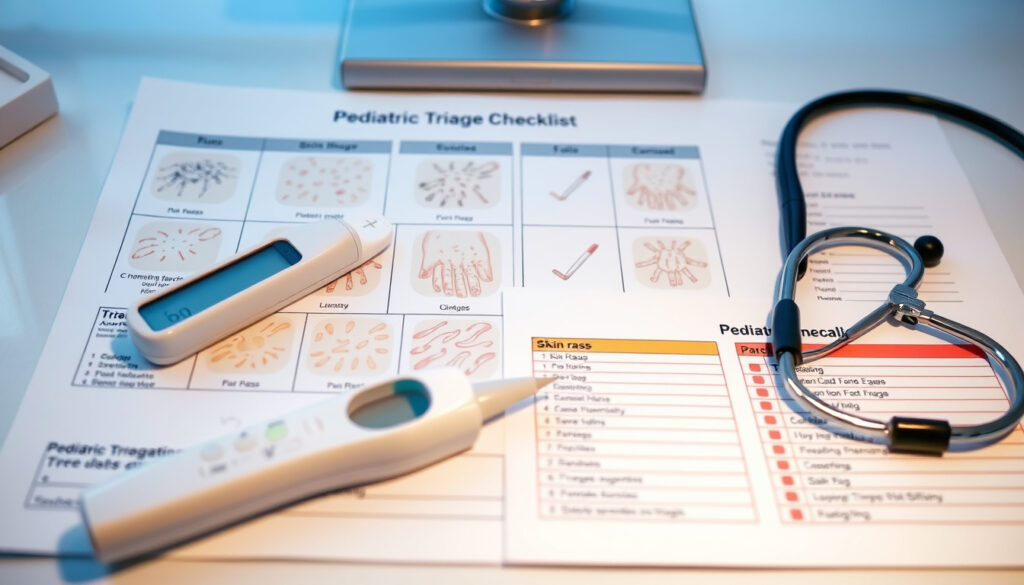
Child Rash: When to Worry – Pediatric Triage Guide
Every parent knows the moment: your child is fussy, you notice spots on their skin, and your mind races to the worst possibilities. As a pediatrician at Johns Hopkins Medicine explains, the child’s overall behavior and energy level are far more telling than the rash pattern. This triage guide, built from pediatric ER frameworks, gives you a clear decision path so you know exactly when to call the doctor and when to stay calm at home.
Non‑blanching rash: key red flag for meningitis ·
Rash can be harder to see on darker skin: check inside eyelids, soles ·
Meningitis progression: rash may follow fever, vomiting, limb pain ·
Glass test: press clear glass – if spots remain, seek emergency help
Quick snapshot
- Meningitis rash does not blanch under glass (NHS (UK national health authority)).
- Child’s behavior is the most reliable severity indicator (Johns Hopkins Medicine (leading academic medical center)).
- RSV rash is fine, pink, and blotchy on trunk and face (Royal Children’s Hospital Melbourne (Australia’s largest pediatric hospital)).
- Exact percentage of RSV cases presenting with rash varies across studies (GoodRx (pharmacy content platform)).
- Meningitis symptoms often start with fever, vomiting, and headache before rash appears (Meningitis Research Foundation (UK meningitis charity)).
- Limb pain, pale skin, and cold hands and feet may appear earlier than the rash (Meningitis Research Foundation). (Meningitis Research Foundation (UK meningitis charity))
- Rash can spread rapidly from pinprick spots to large purpuric areas within hours (HSE (Irish health service)).
- If the glass test is positive (rash does not fade): go to the ER immediately.
- If fever over 102°F with rash and child appears ill: see a doctor today.
- If child is playing, eating, and acting normally: monitor at home and contact pediatrician if rash persists beyond 48 hours.
The table below summarizes key characteristics of different rash types and their associated warning signs.
| Label | Value |
|---|---|
| Non‑blanching rash warning | Does not fade under glass (NHS) |
| Meningitis rash type | Petechial (pinprick) or purpuric (bruise‑like) (Meningitis Research Foundation) |
| Glass test procedure | Press clear glass against spots – if they remain visible, seek emergency help (NHS) |
| Early signs before rash | Fever, vomiting, limb pain, pale skin (Meningitis Research Foundation) |
| Rash on darker skin | Harder to see; check inside eyelids, palms, soles (NHS) |
| Meningitis as late feature | Neck stiffness, photophobia, hemorrhagic rash appear late (PubMed Central (peer‑reviewed medical database)) |
| RSV rash frequency | Present in 10–20% of RSV cases (GoodRx) |
| Infants under 3 months | Any fever with rash needs immediate medical evaluation (Mayo Clinic (nonprofit academic medical center)) |
A child’s demeanor is your best guide. An active, playful child with a rash is almost never an emergency. A lethargic, limp child with the same rash needs immediate evaluation.
How to tell if a child’s rash is serious?
When your child breaks out, the first instinct is to focus on the rash itself. But the most reliable triage tool isn’t the rash pattern — it’s your child’s overall appearance. Pediatric ERs use a top‑down check: breathing, alertness, and energy.
Using the child’s overall appearance as the first check
- Does your child look and act normally? Playing, smiling, eating? Then the rash is very unlikely to be serious (Johns Hopkins Medicine).
- Is your child unusually sleepy, irritable, or difficult to wake? That’s a red flag regardless of the rash.
- Trouble breathing or swallowing with any rash means call 911 or 999 right away (NHS).
The glass test for meningitis rash
The glass test is a proven, simple method. Press the bottom of a clear drinking glass firmly against the rash. If the spots disappear under pressure, it’s a blanching rash — usually not meningitis. If they stay visible, it could be a non‑blanching rash indicating meningococcal disease (Meningitis Research Foundation). This test is especially important because the rash can start as tiny red pinpricks that look like flea bites (Meningitis Research Foundation).
On darker skin, a meningitis rash can be harder to see. NHS recommends checking the soles of the feet, palms, and inside the eyelids for purple or red spots.
Fever with rash: when to worry
- Fever above 102°F (39°C) with a rash needs same‑day medical evaluation (Mayo Clinic).
- High fever along with a non‑blanching rash is a medical emergency.
- If the fever has been present for several days and the rash appears after the fever drops, it’s likely a viral exanthem like roseola — less concerning.
Bottom line: The child’s behavior is the anchor. A happy, alert child with a rash rarely needs the ER. A lethargic child with the same rash requires immediate attention.
When to take a child to the doctor for a rash?
Knowing where to go — emergency room, urgent care, or pediatrician — can save time and reduce worry. The decision depends on accompanying symptoms more than the rash itself.
Immediate ER warning signs: stiff neck, light sensitivity, confusion
- Stiff neck (difficulty touching chin to chest) with rash: emergency (NHS Inform (Scottish health service)).
- Photophobia (pain from bright lights) or confusion also mandate ER care.
- Limb pain, cold hands and feet, and pale skin may precede the rash — don’t wait for the rash to appear (Meningitis Research Foundation).
Urgent care signs: fever over 100.4°F in infant under 3 months
- Infants younger than 3 months with any fever and rash should be seen by a doctor immediately (Mayo Clinic).
- Rash that is painful, spreading rapidly, or accompanied by swelling requires urgent care.
- If your child has not had a wet diaper in 8+ hours, dehydration may be compounding the issue.
Non‑urgent but consult: rash lasting more than 48 hours
- A rash that persists beyond two days without improvement warrants a call to your pediatrician.
- Itching that disrupts sleep can be treated with antihistamines, but if the rash is getting worse, a professional opinion is smart.
- Most viral rashes resolve in 3–7 days without treatment (Royal Children’s Hospital Melbourne).
Bottom line: Use the child’s age, fever height, and ability to move their neck as your triage dial. Infants under 3 months always get immediate care.
What does a meningitis rash look like on a child?
The meningitis rash can look very different depending on the stage and the child’s skin tone. Knowing how to recognize it — and when to act — is critical.
Typical appearance: tiny red, brown, or purple pinprick spots (petechiae)
- The rash often starts as small red or purple dots called petechiae. They can be mistaken for flea bites (Meningitis Research Foundation).
- It can appear on any part of the body, including palms and soles (CDC (U.S. public health agency)).
- The rash may quickly spread and become larger, bruise‑like blotches (purpura).
How to perform the glass test correctly
- Use a clear drinking glass — not a textured one.
- Press it firmly against the spots. If they do not fade, the rash is non‑blanching.
- If the glass test is positive, seek emergency care without delay (GOV.UK (UK government health guidance)).
Rash progression: from spots to larger bruise‑like areas
- What starts as a few pinprick spots can turn into large purple or black patches within a few hours (NHS).
- As the infection worsens, the skin may become mottled or discolored.
- Remember: the rash may be the last sign to appear. Earlier symptoms like leg pain and cold hands are equally important (PubMed Central).
Bottom line: A non‑blanching rash, even a few tiny spots, demands immediate hospital assessment. Don’t wait for it to spread.
What does RSV rash look like?
Respiratory syncytial virus (RSV) is common in children and sometimes causes a rash. Recognizing it can avoid unnecessary alarm.
RSV rash: fine, pink, blotchy rash on trunk and face
- The rash is typically a fine, pink, maculopapular rash (flat and raised spots) on the torso and face (Royal Children’s Hospital Melbourne).
- It may be faint and is often more noticeable after the fever breaks.
- Not all children with RSV develop a rash — estimates range from 10–20% (GoodRx).
Distinguishing RSV rash from viral exanthems
- RSV rash lacks the “slapped cheek” appearance of fifth disease or the full‑body redness of measles.
- It is usually non‑itchy and resolves on its own within a few days.
- The rash alone cannot confirm RSV; respiratory symptoms like coughing, wheezing, and runny nose are essential.
RSV rash typically appears after fever breaks
- In many viral illnesses, a rash appears after the fever drops — this is called a “post‑fever rash.”
- Roseola (human herpesvirus 6) follows the same pattern: high fever for 3–4 days, then a pink rash as the fever resolves.
- If the rash appears while fever is still high and your child is ill, it’s more likely to be a serious bacterial infection.
Bottom line: RSV rash is generally mild and self‑limiting. Call the doctor if breathing becomes difficult or your child is working hard to breathe.
What are the red flags for rashes?
Some symptoms, when paired with a rash, signal an urgent need for care. Use this checklist to decide quickly.
Red flags: fever, lethargy, stiff neck, light sensitivity
- Fever above 100.4°F (38°C) plus rash in any infant under 3 months: emergency.
- Lethargy (child is difficult to wake or unusually sleepy) is a major red flag.
- Stiff neck and photophobia often indicate meningitis (NHS Inform).
Rash characteristics: petechiae, blistering, rapid spread
- Any non‑blanching petechiae or purpura is a red flag.
- Blistering rash (especially with fever) could indicate staphylococcal scalded skin syndrome or toxic shock.
- A rash that spreads rapidly — from a few spots to large areas in hours — needs urgent evaluation.
Systemic symptoms: trouble breathing, persistent vomiting
- Difficulty breathing or swallowing with a rash means call 911 (American Academy of Pediatrics (national pediatric authority)).
- Persistent vomiting with a rash can be a sign of sepsis.
- If your child is too weak to stand or drink, go to the ER now.
Bottom line: A rash alone is rarely the emergency. A rash plus one of these systemic red flags demands immediate action.
What does a bacterial rash look like?
Bacterial rashes are less common than viral rashes but often require antibiotics. Here’s what to watch for.
Common bacterial rashes: impetigo, scarlet fever, cellulitis
- Impetigo: honey‑colored crusted sores, often around nose and mouth (NHS).
- Scarlet fever: fine, sandpaper‑like rash on trunk, “strawberry tongue,” and fever (CDC).
- Cellulitis: red, warm, swollen skin with an advancing border; red streaks may appear (Mayo Clinic).
Bacterial rash signs: honey‑colored crusts, red streaks, swelling
- Honey‑colored crusts are classic for impetigo.
- Red streaks extending from the rash (lymphangitis) suggest spreading infection.
- Swelling that grows larger or more painful over a few hours needs urgent care.
Bacterial rash vs viral rash: how to differentiate
- Bacterial rashes are often painful, localized, and accompanied by high fever.
- Viral rashes are usually widespread, non‑painful, and follow a febrile illness.
- If the rash appears crusty, blistery, or has an advancing edge, think bacterial.
Bottom line: Bacterial rashes need medical treatment. If your child has honey‑colored sores or red streaks, see a doctor today.
Confirmed facts
- Meningitis rash does not blanch under glass (NHS).
- Child’s behavior is the most reliable severity indicator (Johns Hopkins Medicine).
- RSV rash is fine, pink, maculopapular on trunk and face (Royal Children’s Hospital Melbourne).
What’s unclear
- Exact percentage of RSV cases that present with rash varies by study (GoodRx).
“Your child’s behavior is the single most important clue. A child who is playing and interacting normally is almost never in immediate danger, regardless of the rash.”
Dr. Ashanti Woods, pediatrician at Mercy Medical Center, via Johns Hopkins Medicine
“A red or purple bruised or blotchy rash that does not fade under pressure is a warning sign — do the glass test.”
“Fever above 102°F with rash requires evaluation to rule out serious bacterial infection.”
For parents, the bottom line is reassuring: more than 98% of rash‑related ER visits are not emergencies. Trust your child’s demeanor as your guide. When in doubt, the glass test and a quick call to your pediatrician can save you both worry and time. For families in the U.S., the choice is clear: use the triage framework here to decide between a calm night at home and a prompt visit to urgent care.
consultant360.com, fletcherssolicitors.co.uk, youtube.com, 111.wales.nhs.uk, bbc.com, meningitisnow.org
Frequently asked questions
Can teething cause a rash?
Teething itself does not cause a body rash. Drool around the mouth can cause a mild chapped rash (drool rash), but a full‑body rash is not a sign of teething.
Is a rash always a sign of infection?
No. Rashes can also be caused by allergies, heat, friction, or eczema. Infection is one possible cause but not the only one.
Can allergies cause a rash in children?
Yes. Hives (urticaria) are the most common allergic rash — raised, red, itchy welts that come and go. Food allergies and poison ivy are frequent triggers.
Should I apply cream to my child’s rash?
If the rash is dry and itchy, a fragrance‑free moisturizer or 1% hydrocortisone cream (for non‑facial areas) can help. Avoid creams if you suspect a bacterial infection.
How long do viral rashes last?
Most viral rashes resolve in 3 to 7 days without treatment. If it lasts longer than 10 days or gets worse, consult your pediatrician.
Can a child have a full body rash without fever?
Yes. Conditions like urticaria, heat rash (miliaria), eczema, and some viral rashes (like roseola after the fever) can produce a body rash without a concurrent fever.
More related posts
 The Godfather Part 2: Why It’s Better Than the Original
 iPhone SE 1st Generation to Buy – Prices, Sites and Guide 2025
 2025 Jeep Grand Cherokee: Price, Specs & Reliability
 Shows in Las Vegas 2026: Best Shows, Budget Tips & More
 James L. Avery: Cause of Death and Biography
 Gutter Installation Near Me: Costs, Sizes & Best Time
 Gold Bracelets for Women: 2026 Trends & Styles Guide
 SC State vs South Carolina: History, Score, and Payment Details