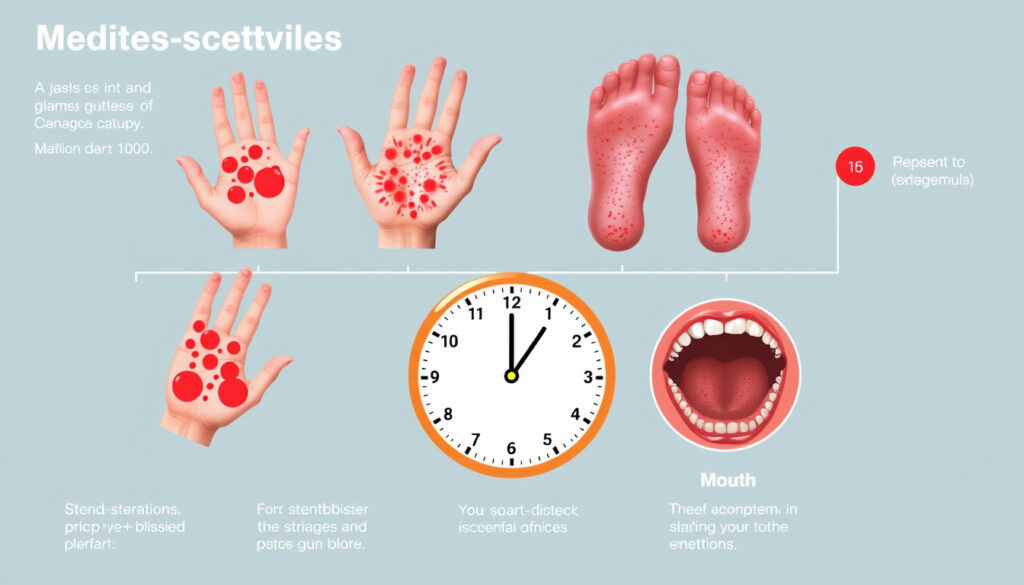
Hand Foot and Mouth Disease Symptoms: Progression & Timeline
When your child suddenly develops a fever and starts complaining of a sore throat, it’s easy to worry. But if you notice small blisters on their hands and feet a day or two later, you’re likely dealing with hand, foot, and mouth disease (HFMD) – a common viral illness that usually runs its course without serious complications, according to the Health Service Executive (HSE, Ireland’s health authority) and the Mayo Clinic.
Average incubation period: 3 to 6 days ·
Common time to recovery: 7 to 10 days ·
Peak contagious period: first 3 to 5 days of illness ·
Highest risk age group: children under 5 years ·
Main cause: coxsackievirus (most often A16)
Quick snapshot
- Why some adults develop severe symptoms while others remain asymptomatic (University of California, Riverside)
- Long-term immunity patterns after infection (multiple serotypes exist) (PAHO) (University of California, Riverside)
- Recovery usually complete within 7–10 days with supportive care (Mayo Clinic)
- Watch for dehydration if mouth sores make drinking painful (CDC)
- Consult a doctor if high fever persists or neurological symptoms appear (HSE)
The table below summarizes key characteristics of hand, foot, and mouth disease.
| Attribute | Value |
|---|---|
| Age group most affected | Children under 5 years old |
| Incubation period | 3 to 6 days |
| Duration of illness | 7 to 10 days |
| Most common virus | Coxsackievirus A16 |
| Main transmission routes | Respiratory droplets, stool, blister fluid (UCR) |
| Treatment | Supportive care (no specific antiviral) (PAHO) |
| Contagious period | Most contagious first week; virus can shed in stool for weeks (Medical News Today) |
| Return to school | When fever gone and blisters dried, usually 24h after fever resolves (CDC) |
What symptoms come first with hand-foot-and-mouth?
Early signs: fever, sore throat, loss of appetite
- The HSE lists the first symptoms as a sore throat, high temperature above 38°C, and reduced interest in milk feeds or food.
- These initial signs appear 3 to 5 days after exposure to the virus.
- Children may become irritable and complain of feeling unwell before any rash shows.
Progression to mouth sores and skin rash
- Mouth ulcers and a rash usually appear after a few days, according to the HSE.
- The NHS Inform notes that mouth ulcers can appear 1 to 2 days after early spots on the tongue and inside the mouth.
- The rash often starts as red spots that turn into blisters, commonly on the palms, soles, and sometimes the buttocks.
Timeline of symptom appearance (days 1–7)
Six patients, one pattern: the symptom sequence is consistent across most cases, though timing varies slightly.
- Day 0–3: Exposure and incubation; no symptoms (HSE).
- Day 3–5: Fever, sore throat, loss of appetite appear (HSE).
- Day 5–7: Mouth sores and rash on hands and feet develop; this is the most contagious phase (CDC).
Why this matters: Recognizing the progression helps parents distinguish HFMD from other childhood fevers and avoid unnecessary anxiety about the rash.
How long is hand foot mouth contagious for?
Contagious period: before and after symptoms
- The CDC states that people are most contagious during the first week of illness.
- However, the virus can be shed in stool for weeks after recovery, and even people without symptoms can spread it (Medical News Today).
- Transmission occurs through respiratory droplets, direct contact with blister fluid, and contact with contaminated surfaces.
Peak contagious time: first 3 to 5 days
- According to UCR, the virus spreads through respiratory droplets, stool, and fluid from skin blisters.
- Close contact with an infected person – sharing utensils, kissing, or playing – poses the highest risk.
- Hand hygiene and cleaning surfaces are the most effective prevention measures, as recommended by the CDC.
When is it safe to return to school or work
- The CDC advises that children should stay home while they have a fever and open blisters.
- Most guidelines, including those from the HSE, recommend staying home until blisters have dried and fever is gone for 24 hours.
- No formal quarantine is required for exposed adults unless symptoms develop.
The catch: Even after symptoms resolve, the virus can still be present in stool for weeks, so rigorous hand washing after diaper changes remains critical.
Can adults get hand, foot, and mouth from kids?
Adult infection: possible, but often milder or asymptomatic
- UCR reports that adults can catch HFMD, even though it is usually seen in children under 5.
- Many adults experience mild or no symptoms, but some develop prolonged fever or painful mouth sores.
- The Mayo Clinic notes that coxsackievirus A16 is a common cause, and adult cases are often linked to caring for infected children.
Transmission routes: close contact, saliva, respiratory droplets
- HFMD spreads through direct contact with nose and throat secretions, blister fluid, or stool (CDC).
- Kissing, sharing drinks, or touching contaminated surfaces can transmit the virus.
- Good hand hygiene is the most effective preventive measure, especially after changing diapers or wiping noses.
Why adults may have more severe symptoms
- Medical News Today suggests that adults who were not exposed as children may lack partial immunity, leading to a more robust immune response and more severe symptoms.
- Some adults report high fever, extensive mouth ulcers, and joint pain, though severe complications are rare.
- The PAHO notes that most cases are self-limiting and require only supportive care.
What this means: Parents and caregivers should be aware of their own risk, especially if their child is infected, and take precautions like not sharing utensils and washing hands frequently.
How long does it take for hand and foot to go away?
Typical recovery timeline: 7 to 10 days
- The Mayo Clinic states that most people recover in 7 to 10 days.
- Fever usually resolves within 2–3 days, while mouth ulcers and rash may take up to a week to heal.
- Blisters often dry and crust over before healing completely.
Factors that affect healing time
- Age: younger children tend to recover faster, while adults may have a slightly longer course.
- Immune status: immunocompromised individuals may experience prolonged symptoms.
- Hydration and nutrition: maintaining fluid intake is crucial, as painful mouth sores can lead to dehydration.
When to contact a doctor
- The HSE advises seeking medical attention if dehydration, high fever lasting more than 3 days, or neurological symptoms (confusion, stiff neck) occur.
- Pregnant women should consult their doctor if exposed or infected.
- Rare complications include viral meningitis, though the CDC notes that HFMD is usually mild.
The trade-off: While most cases resolve without intervention, the discomfort from mouth sores can make the recovery period tough for children and adults alike. Over-the-counter pain relievers and cool fluids can help.
Do I need to quarantine if my kid has hand, foot, and mouth?
Official quarantine or exclusion guidelines (HSE, CDC)
- The CDC recommends that children with HFMD stay home while they have a fever and open blisters.
- The HSE advises that children should not attend school or childcare until blisters have dried and fever has resolved for 24 hours.
- No formal quarantine is required for asymptomatic household members, but they should monitor for symptoms.
When children can return to school or childcare
- Most health authorities agree: return once fever is gone for 24 hours and blisters have crusted over.
- Some schools may require a note from a doctor, but this is not standard practice.
- Good hand hygiene should continue even after return, as the virus can still be present in stool.
Minimizing spread within the household
- CDC recommends cleaning and disinfecting surfaces, especially toys, doorknobs, and bathroom fixtures.
- Avoid sharing towels, cups, and utensils.
- Wash hands frequently with soap and water, especially after diaper changes or contact with saliva.
Why this matters: The virus is highly contagious, but with simple hygiene measures, families can reduce the risk of spreading it to other children and adults.
Timeline: Hand, foot, and mouth disease day by day
Exposure and incubation; no symptoms yet (HSE)
First symptoms appear: fever, sore throat, loss of appetite (HSE)
Mouth sores and rash on hands and feet appear; most contagious (CDC)
Blisters begin to dry and heal; symptoms resolve (Mayo Clinic)
Confirmed facts vs. what remains unclear
Confirmed facts
- HFMD is caused primarily by coxsackievirus A16 and enterovirus 71 (PAHO)
- Symptoms appear 3–6 days after exposure (HSE)
- Illness typically lasts 7–10 days (Mayo Clinic)
- No specific treatment; supportive care is recommended (PAHO)
What’s unclear
- Why some adults develop severe symptoms while others remain asymptomatic (UCR)
- Long-term immunity patterns after infection (multiple serotypes exist) (PAHO)
- Duration of virus shedding in asymptomatic individuals (Medical News Today)
What health authorities say
Hand, foot, and mouth disease is a common viral illness that typically causes fever, mouth sores, and a skin rash. The best prevention is hand washing and avoiding close contact with infected people.
Centers for Disease Control and Prevention (CDC)
Symptoms usually take 3 to 5 days to develop after infection. The first signs are a sore throat, a high temperature above 38°C, and not wanting to eat. Mouth ulcers and a rash appear after a few days.
Health Service Executive (HSE, Ireland)
Most people recover in 7 to 10 days. Coxsackievirus A16 is a common cause. There is no specific treatment, but over-the-counter pain relievers and cool fluids can help.
Mayo Clinic
Parents who recognize the early signs of HFMD – fever, sore throat, refusal to eat – can start supportive care early and reduce the risk of dehydration. The CDC emphasizes that most cases are mild, but knowing the contagious period helps families make informed decisions about school attendance and household hygiene.
Adults who care for infected children are at risk of catching HFMD, and some may experience more severe symptoms than kids. The PAHO alert from March 2025 highlights that Coxsackievirus A16 and Enterovirus A71 are the main causes, but other enterovirus serotypes can also trigger outbreaks.
For parents and caregivers in Ireland and the US, the choice is clear: recognize the early signs, isolate during the contagious period, and focus on hydration and comfort. Adults who catch it should rest and treat symptoms, but most will recover without complications. The trade-off between keeping a child home and preventing spread is worth it – a few days of caution can save weeks of family-wide illness.
cdc.gov, medicalnewstoday.com, dchealth.dc.gov, healthline.com, vinmec.com, nicd.ac.za, nhsinform.scot
Parents often wonder how the illness unfolds, and a helpful overview of the early signs and timeline of HFMD can be found at early signs and timeline of HFMD.
Frequently asked questions
What does the hand foot and mouth rash look like?
The rash typically appears as red spots that develop into small blisters, often on the palms of the hands, soles of the feet, and sometimes on the buttocks. The CDC describes it as a flat, red rash that may blister.
Can my child go to daycare with hand foot and mouth?
No. Most health authorities, including the HSE and CDC, recommend keeping children home until fever is gone for 24 hours and blisters have dried.
Is hand foot and mouth disease the same as hoof and mouth?
No. They are different diseases. HFMD is caused by enteroviruses and affects humans, while hoof-and-mouth disease (foot-and-mouth disease) is caused by a different virus and affects livestock. They are not related.
Do adults need treatment for hand foot and mouth?
Most adults recover with supportive care: rest, fluids, and over-the-counter pain relievers. The PAHO notes that there is no specific treatment, but symptoms are usually mild.
How long does the fever last in hand foot and mouth?
Fever usually lasts 2 to 3 days, according to the Mayo Clinic. If it persists beyond 3 days, consult a doctor.
Can hand foot and mouth cause vomiting or diarrhea?
Some children may experience mild gastrointestinal symptoms, but vomiting and diarrhea are not typical. The CDC lists fever, mouth sores, and rash as the main symptoms.
Should I pop the blisters on my child’s hands?
No. Popping blisters can increase the risk of infection. The HSE advises keeping blisters clean and dry, and letting them heal naturally.
How is hand foot and mouth diagnosed?
Doctors usually diagnose HFMD based on the appearance of the rash and mouth sores, along with the presence of fever. The Mayo Clinic notes that lab tests are rarely needed.
More related posts
 Ford Raptor for Sale: Prices & Used in Ireland
 Jada Pinkett Smith Young: 90s Photos, Tupac & Early Life
 37 Celsius to Fahrenheit: Is It a Fever? Conversion Guide
 Cloudy With A Chance Of Meatballs Cast – Full Voice Actors List
 National Best Friends Day 2026: Date and 11-3-6 Rule
 New York Yankees vs Red Sox Matches: Scores, Stats, History
 The Legend of Korra: LGBTQ+ Rep, Disability, and Where to Watch
 Signs of Low Blood Sugar: Symptoms, Causes & Treatment