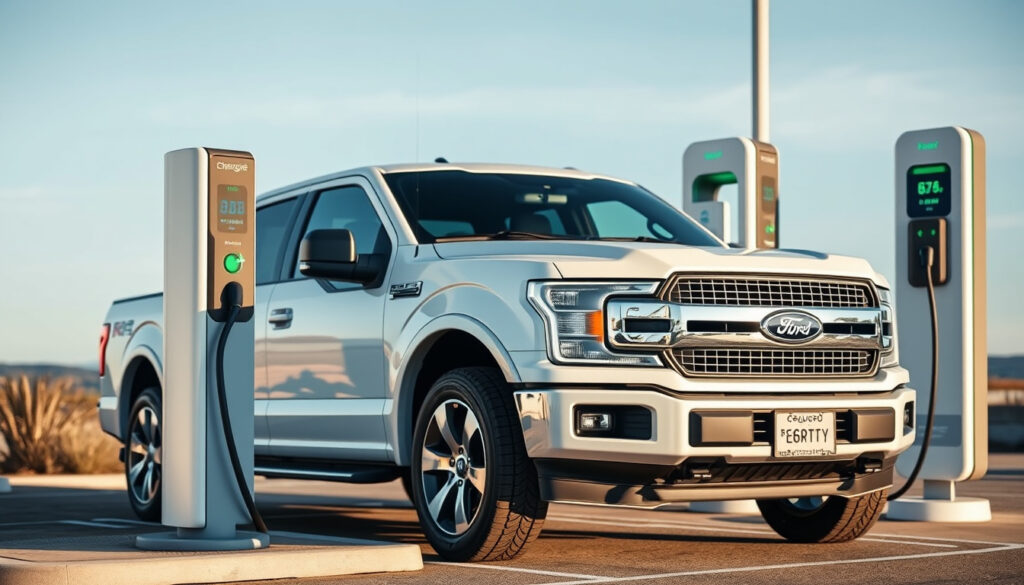
2025 Ford F-150 Lightning: Price, Problems & Battery Life
When Ford unveiled the F-150 Lightning in 2021, it felt like a watershed moment for electric trucks. But a few years later, the buzz has cooled as this guide examines why sales slowed, what the 2025 model costs, and what owners report about battery life and reliability.
Starting price (2025 model): approximately $62,000 ·
EPA-estimated maximum range: 320 miles (extended range battery) ·
Horsepower (standard model): 580 hp ·
Torque: 775 lb-ft ·
Maximum payload capacity: 2,235 pounds ·
Maximum towing capacity: 10,000 pounds
Quick snapshot
- 2025 Pro trim starts around $62,000 (Edmunds (automotive pricing authority))
- Extended range battery delivers 320 miles EPA (Car and Driver (auto review specialist))
- Battery warranty: 8 years / 100,000 miles (Ford official spec sheet)
- Consumer Reports 2023 reliability rating: Below average (Consumer Reports (nonprofit testing org))
- Exact 2024 unit sales (final industry data pending)
- Whether Ford will launch a major redesign before 2027
- Real-world battery degradation rate beyond 10 years
- Impact of future EV tax credit changes on demand
- : Ford unveils the F-150 Lightning
- : Production begins at Rouge Electric Vehicle Center
- : Consumer Reports reliability survey rates Lightning below average
- : Ford temporarily halts production to address demand
- : 2025 model year released with pricing adjustments
- 2025 model year continues with lower prices on some trims (Kelley Blue Book (auto valuation authority))
- Federal EV tax credit ended as of October 2025 (Autoweb (automotive news source))
- Possible mid-cycle refresh or new trim to revive interest (Kelley Blue Book (auto valuation authority))
Six key facts, one pattern: the Lightning still impresses on paper but faces price and reliability headwinds.
| Attribute | Value |
|---|---|
| Starting MSRP (2025 Pro) | $62,000 |
| EPA range (extended battery) | 320 miles |
| Horsepower | 580 hp |
| Battery warranty | 8 years / 100,000 miles |
| Maximum towing | 10,000 lbs |
| Consumer Reports reliability rating (2023) | Below average |
Why is the Ford F-150 Lightning not selling?
Demand vs. production mismatch
- Ford initially geared up for massive production, but by early 2024 it temporarily halted production to realign with demand.
- Edmunds reported that in 2025 the Lightning had only 272 new vehicles nationwide in inventory — yet a median days-to-turn of 249 days, compared to 44 days for the market average (Edmunds). That means even the few trucks on lots sit for months.
- Buyers are paying an average of $5,300 under MSRP, a clear sign of weak demand (Edmunds).
Ford ramped up capacity for a market that didn’t materialize at the promised price point. The result: a truck that moves slowly even at a discount.
Competition from other electric trucks
- The Tesla Cybertruck and Chevrolet Silverado EV have entered the segment, giving buyers more options.
- MotorTrend noted that the 2025 Flash trim was introduced as a value-oriented option to broaden appeal (MotorTrend (auto industry analysis)).
Price sensitivity among truck buyers
- A 2025 Hooniverse review compared a Lightning Lariat ($79,985) to a similarly equipped gas F-150 PowerBoost ($75,815), showing the EV still carries a premium (Hooniverse (automotive enthusiast site)).
- With the federal tax credit eliminated as of October 2025 (Autoweb), the price gap widens.
The implication: Ford built a truck that traditional truck buyers find too expensive, while EV enthusiasts wait for faster charging or more range. The Lightning sits in a no-man’s-land between two audiences.
How much does a Ford F-150 Lightning cost?
2025 model year pricing by trim
- Pro Fleet (fleet-only): $49,780 including destination (Edmunds)
- Pro (retail, with larger battery): ~$54,975 (Kelley Blue Book)
- XLT: starts around $60,000 (estimated)
- Flash: ~$67,000 (value-oriented trim, per MotorTrend)
- Lariat: ~$79,985 (Hooniverse)
- Platinum: up to $87,190 (Kelley Blue Book)
Incentives and tax credits
- The federal EV tax credit ended in October 2025 (Autoweb).
- Some state incentives still apply, but they vary widely.
- Ford has offered dealer cash and special financing to move inventory.
Total cost of ownership vs. gas F-150
- Fuel savings can offset the higher upfront cost over 5-7 years, but only if you charge at home regularly.
- Insurance and repair costs tend to be higher for EVs, and the Lightning’s below-average reliability rating adds risk.
What this means: the Lightning can make financial sense for high-mileage fleet buyers with access to cheap charging, but retail buyers face a tough equation — especially after the tax credit disappeared.
Five trims, one pattern: the price ladder climbs steeply, and even the base model isn’t truly base for non-fleet buyers.
| Specification | Details |
|---|---|
| Drivetrain | Dual-motor all-wheel drive (Ford official spec sheet) |
| Motors | Two inboard three-phase fixed magnet AC motors (Ford official spec sheet) |
| Battery (standard range) | 98 kWh (usable capacity) |
| Battery (extended range) | 131 kWh (usable capacity) |
| EPA range (standard) | 230 miles |
| EPA range (extended) | 320 miles |
| Horsepower | 580 hp |
| Torque | 775 lb-ft |
| Payload capacity | Up to 2,235 lbs |
| Towing capacity | Up to 10,000 lbs |
| Charging (DC fast) | Up to 150 kW (10-80% in ~40 min) |
| Warranty (battery) | 8 years / 100,000 miles |
Upsides
- Class-leading power and torque for an electric truck
- Viable range for daily driving and light towing
- Pro Power Onboard can power tools or a house
- Improved pricing for 2025 vs. earlier model years
Downsides
- Below-average reliability per Consumer Reports
- Slow charging speed compared to rivals (150 kW max)
- High starting price, especially after tax credit loss
- Limited availability of base Pro trim for retail buyers
What are the common problems with the F-150 Lightning?
Battery software issues and recalls
- The National Highway Traffic Safety Administration (NHTSA) has issued recalls for the Lightning, including a 2023 recall for a faulty wiper motor.
- Some owners have reported battery management software glitches that temporarily limit power or range.
Charging speed complaints
- With a maximum DC fast-charge rate of 150 kW, the Lightning charges slower than the Tesla Cybertruck (250 kW) or Hyundai Ioniq 5 (350 kW).
- Real-world charging sessions often fall short of the 150 kW peak, especially in cold weather.
Build quality and service center reports
- Consumer Reports’ 2023 survey rated the Lightning below average for reliability, citing issues with power equipment and body hardware.
- Service center wait times have been a common complaint on forums, with some owners waiting weeks for repairs.
If you’re considering a Lightning, check the vehicle’s recall history and ensure your local Ford dealer has EV-certified technicians. The reliability gap matters more for a daily driver than a novelty.
The trade-off: raw performance and utility come with a higher risk of visits to the shop — and longer waits when you go.
Is the F-150 Lightning discontinued?
Ford’s official 2025 production plans
- Ford has confirmed the 2025 model year is in production, with updated trims like the Flash (Autoweb).
- The Lightning is not discontinued; it remains a key part of Ford’s EV lineup.
Production line adjustments in 2024
- In early 2024, Ford paused production for several weeks to adjust output to demand (Autoweb).
- The Rouge Electric Vehicle Center continues to build the Lightning, albeit at a slower pace.
Future of the Lightning nameplate
- Ford has not announced a next-generation Lightning, but a mid-cycle refresh is expected by 2027.
- The company’s EV strategy update in 2024 emphasized profitability over volume, so the Lightning will likely evolve rather than disappear.
The pattern: rumors of cancellation are exaggerated. The Lightning is alive, but Ford is recalibrating its ambitions.
What is the battery life expectancy on an F-150 Lightning?
Ford’s battery warranty terms
- Ford covers the battery for 8 years or 100,000 miles, whichever comes first (Ford official spec sheet).
- The warranty guarantees at least 70% capacity retention during that period.
Real-world battery degradation data
- Long-term data is still scarce, but fleet reports suggest minimal degradation in the first 3-4 years.
- Factors like frequent DC fast charging and extreme temperatures can accelerate wear.
Factors affecting battery longevity
- Charging habits: regular use of Level 1 or 2 is gentler than frequent DC fast charging.
- Climate: hot climates increase degradation rates.
- Usage: heavy towing and high-speed driving drain the battery faster and may impact cycle life.
Why this matters: the battery is the most expensive component to replace. The warranty gives peace of mind for the first 8 years, but owners who keep the truck longer should plan for eventual capacity loss.
Timeline
- : Ford unveils the F-150 Lightning electric pickup.
- : Production begins at Rouge Electric Vehicle Center.
- : Consumer Reports reliability survey rates Lightning below average.
- : Ford temporarily halts Lightning production to address demand.
- : 2025 model year released with pricing adjustments and updates.
Confirmed facts vs. what’s unclear
Confirmed facts
- Ford sells the 2025 F-150 Lightning (Edmunds (automotive pricing authority))
- Starting price is approximately $62,000 for Pro trim
- Extended range battery delivers EPA-estimated 320 miles
- Standard warranty includes 8 years/100,000 miles for battery
- Sales slowed significantly in 2024 compared to 2022-2023
- Ford lowered prices on certain trims for 2025
What’s unclear
- Exact number of units sold in 2024 (final industry data pending)
- Whether Ford will introduce a substantial redesign or next-generation model by 2027
- Real-world average battery degradation rate over 10+ years
- Impact of future EV tax credit changes on Lightning demand
- Whether the 2025 pricing adjustments will be sufficient to boost sales meaningfully
- Long-term resale value compared to gasoline F-150 models
What experts say
“Shoppers are paying about $5,300 under MSRP on the 2025 F-150 Lightning, which tells you the market is not hot.”
— Edmunds (automotive pricing authority) Edmunds
“The 2023 F-150 Lightning scored below average in our reliability survey, with owner-reported issues in power equipment and body hardware.”
— Consumer Reports (nonprofit testing organization) Consumer Reports
“As of October 2025, the F-150 Lightning and other plug-in cars are no longer eligible for federal tax credits.”
— Autoweb (automotive news source) Autoweb
The F-150 Lightning is a capable electric truck caught between high expectations and market realities. For buyers who qualify for fleet pricing, have home charging, and can tolerate the reliability risk, it’s a solid workhorse. For the average retail truck buyer, the combination of high price, lost tax credit, and below-average reliability makes the gas or hybrid F-150 a more rational choice. Ford’s challenge is clear: lower costs, improve dependability, and restore the affordability that made the F-150 nameplate a legend — or risk losing the electric truck race to competitors who move faster.
youtube.com, mikewhiteford.com, automotiveaddicts.com, cargurus.com, reddit.com, championfordlincoln.com
For a deeper look at why demand has softened, see this detailed analysis of the F-150 Lightnings sales struggles from a market perspective.
Frequently asked questions
What is the range of the Ford F-150 Lightning?
The standard range battery delivers 230 miles EPA, while the extended range battery offers up to 320 miles.
How much does a Ford F-150 Lightning cost after tax credits?
As of October 2025, the federal EV tax credit has ended. Without it, prices range from about $54,975 for a retail Pro to over $87,000 for a Platinum.
Is the Ford F-150 Lightning eligible for the federal EV tax credit?
No. The program expired in October 2025, and the Lightning is no longer eligible for the federal credit.
What is the warranty on the Ford F-150 Lightning battery?
Ford covers the high-voltage battery for 8 years or 100,000 miles, with a guarantee of at least 70% capacity retention.
How long does it take to charge an F-150 Lightning at home?
On a Level 2 (240V) charger, a full charge takes about 8-10 hours for the standard range battery and 12-14 hours for the extended range.
Can the F-150 Lightning power my house?
Yes, with Ford’s Pro Power Onboard system (up to 9.6 kW) and the optional Home Integration System, the Lightning can back up your home during an outage.
What is the difference between standard range and extended range?
The standard range battery (98 kWh) provides 230 miles of range and is lighter. The extended range (131 kWh) gives 320 miles but adds weight and cost. Most buyers choose extended range for towing or long commutes.
More related posts
 How to Draw a Turkey: Easy Step-by-Step Guide for Kids
 Mango Ice Cream Viral – Thai Sensation’s Origin, Recipe and Availability
 Jada Pinkett Smith Young: 90s Photos, Tupac & Early Life
 Why Is the Moon Orange Tonight? Science, Myths & 2026 Events
 What Is the 25th Amendment? Simple Explanation
 How Old Is Blue Ivy Carter? Age, Birthdate & Siblings
 How Long Until a Tooth Infection Kills You? Timeline & Signs
 Does Dose For Your Liver Work – Evidence And Consumer Data