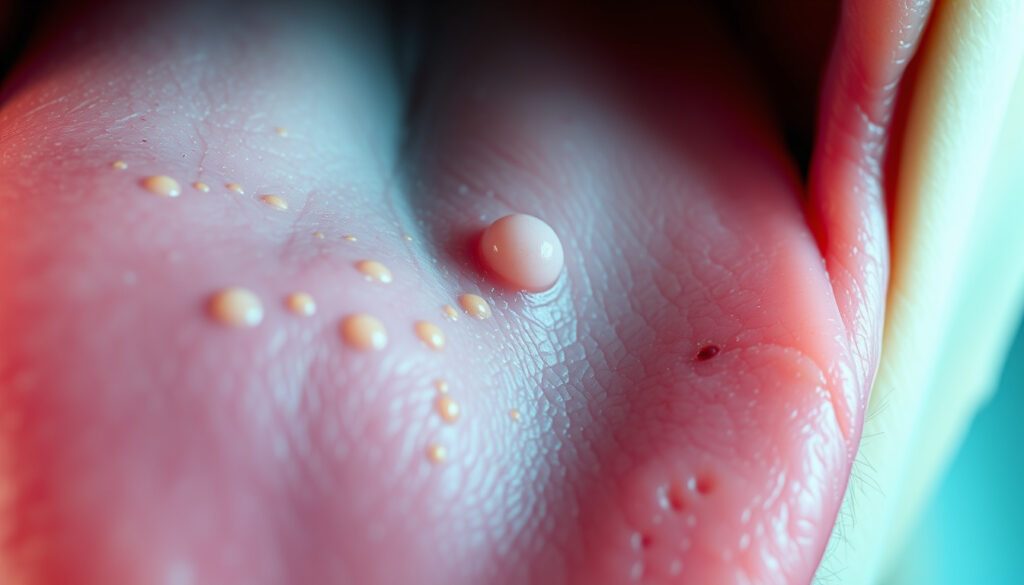
Chlamydia Bumps on Tongue: Symptoms, Causes, and Treatment
If you’ve noticed unusual bumps on your tongue and are worried they might be sign of chlamydia, you’re not alone – many people search for answers about oral STIs. But the reality is more nuanced than a quick internet search suggests. Oral chlamydia is often asymptomatic, and when symptoms do appear, a sore throat is far more common than tongue bumps, according to the CDC (U.S. public health agency). This guide will help you understand what’s actually known about chlamydia and the tongue, how to tell it apart from other conditions, and what steps to take for diagnosis and treatment.
Oral chlamydia often shows no symptoms: 70-80% of cases are asymptomatic ·
Chlamydia is the most common bacterial STI in the U.S.: Over 1.8 million cases reported in 2023 ·
Tongue bumps from chlamydia are rare: Rare manifestation of oral infection
Quick snapshot
- Often none (CDC STI Treatment Guidelines)
- Sore throat, redness, white spots (MouthHealthy (American Dental Association))
- Rare tongue bumps (HealthPartners (health system))
- Chlamydia trachomatis bacteria (CDC STI Treatment Guidelines) (CDC Fact Sheet on Chlamydia)
- Oral sex with infected partner (CDC Fact Sheet on Chlamydia)
- Unprotected genital contact (CDC STI Treatment Guidelines) (CDC Fact Sheet on Chlamydia)
- Physical exam (Healthline (health information publisher))
- Swab test of throat (CDC STI Treatment Guidelines) (Healthline (health information publisher))
- NAAT (nucleic acid amplification test) (CDC STI Treatment Guidelines) (Healthline (health information publisher))
- Antibiotics (azithromycin or doxycycline) (CDC STI Treatment Guidelines) (STDCheck (testing service))
- Abstain from sex during treatment (STDCheck (testing service))
- Test of cure after 3 months (CDC STI Treatment Guidelines) (STDCheck (testing service))
Six key facts, one pattern: most of what we know about oral chlamydia comes from large-scale public health data, not from tongue-specific reports.
| Fact | Value | Source |
|---|---|---|
| Causative bacteria | Chlamydia trachomatis | CDC STI Treatment Guidelines |
| Incubation period | 1–3 weeks | Healthline |
| Common symptoms | Sore throat, swollen lymph nodes, red tonsils | MouthHealthy |
| Rare symptom | Tongue bumps (white or red spots) | HealthPartners |
| Treatment | Azithromycin (single dose) or doxycycline (7 days) | CDC STI Treatment Guidelines |
| Cure rate | Over 95% with proper antibiotic course | CDC STI Treatment Guidelines |
What does chlamydia look like on your tongue?
Typical appearance of oral chlamydia lesions
- Chlamydia tongue bumps are rare and often appear as small white or red spots, according to HealthPartners (health system).
- Lesions may be painless or mildly sore, but Homed-IQ (at-home testing company) notes that bumps on the tongue are not a classic hallmark of chlamydia.
- The CDC (U.S. public health agency) specifically references oropharyngeal infection rather than tongue-specific lesions as a standard diagnostic category.
Tongue bumps are not a reliable sign of chlamydia. If you have bumps, other causes such as lie bumps, HPV, or syphilis are far more likely.
Differences from other tongue bumps (lie bumps, HPV, syphilis)
- Syphilis causes painless chancre sores (MouthHealthy (American Dental Association)).
- HPV causes cauliflower-like bumps (Healthline).
- Herpes causes painful blisters (MouthHealthy).
- Chlamydia bumps are less common and often subtle (Homed-IQ).
The pattern: each STD has a distinct bump signature. Chlamydia’s tongue bumps, if they occur, are the least distinctive. A healthcare provider can usually tell the difference by visual exam alone.
Can you catch chlamydia on your tongue?
Transmission routes for oral chlamydia
- Oral chlamydia is acquired through oral-genital contact with an infected partner, as confirmed by the CDC Fact Sheet on Chlamydia.
- The bacterium Chlamydia trachomatis infects the throat and mouth (CDC STI Treatment Guidelines).
- Condoms and dental dams reduce risk (CDC STI Treatment Guidelines).
Risk factors
- Younger age (prevalence highest among persons aged ≤24 years) (CDC STI Treatment Guidelines).
- Multiple sexual partners and inconsistent condom use (CDC STI Treatment Guidelines).
- WonderHealth (sexual health clinic) notes that most cases of throat chlamydia are asymptomatic, so people may not know they are infected.
Because oral chlamydia is so often silent, the only way to know for sure is to get tested at the site of exposure – a throat swab, not a urine test.
What STD gives you tongue sores?
STDs that cause tongue sores: chlamydia, syphilis, HPV, herpes
- Syphilis causes painless chancre sores (MouthHealthy).
- HPV causes cauliflower-like bumps (Healthline).
- Herpes causes painful blisters (MouthHealthy).
- Chlamydia bumps are less common and often subtle (Homed-IQ).
Key distinguishing features
- Syphilis chancre is usually solitary and painless; chlamydia bumps are rarely solitary (MouthHealthy).
- HPV lesions can be numerous and clustered; chlamydia bumps are more scattered (Healthline).
- Herpes blisters are painful and ulcerate quickly; chlamydia bumps typically do not (MouthHealthy).
The trade-off: if you have tongue bumps, the most likely STD culprits are HPV or herpes – not chlamydia. But a proper test is the only way to be sure.
How can I tell if I have oral chlamydia?
Common symptoms of oral chlamydia
- Most oral chlamydia infections have no symptoms (CDC STI Treatment Guidelines).
- When present: sore throat, redness, swollen tonsils, white spots (MouthHealthy).
- Bumps on the tongue are not a classic symptom (Homed-IQ).
Diagnostic tests (PCR, culture)
- Swab test of throat or tonsils is used for diagnosis (CDC STI Treatment Guidelines).
- NAAT (nucleic acid amplification test) is the preferred method (CDC STI Treatment Guidelines).
- STDCheck (testing service) emphasizes that oral chlamydia is confirmed only by testing.
When to see a healthcare provider
- If you have unexplained tongue bumps that persist for more than a week (Healthline).
- If you have had oral sex with a partner whose STI status is unknown (CDC Fact Sheet on Chlamydia).
- If you experience sore throat, swollen glands, or pain when swallowing (MouthHealthy).
Without testing, you can’t distinguish chlamydia from a viral sore throat or other STDs. A simple throat swab takes seconds and gives you definitive answers.
Is chlamydia curable?
Antibiotic treatment (azithromycin, doxycycline)
- Chlamydia is curable with a course of antibiotics (CDC STI Treatment Guidelines).
- The CDC (U.S. public health agency) recommends doxycycline 100 mg orally twice daily for 7 days as the preferred regimen.
- Azithromycin 1 g orally in a single dose is an alternative (CDC STI Treatment Guidelines wall chart).
- A PubMed Central review (peer-reviewed medical journal) confirms the updated guidelines making doxycycline the preferred regimen.
Follow-up testing
- Retesting after 3 months is recommended (CDC STI Treatment Guidelines).
- STDCheck (testing service) advises abstaining from sex for 7 days while taking antibiotics to avoid transmission and reinfection.
Partner notification and prevention
- Sex partners from the past 60 days should be notified and tested (CDC STI Treatment Guidelines).
- Consistent condom and dental dam use reduces risk (CDC STI Treatment Guidelines).
- Untreated chlamydia can lead to complications like PID in women and epididymitis in men (CDC STI Treatment Guidelines).
The catch: while chlamydia is easily cured with antibiotics, the real challenge is that most people don’t know they have it. That’s why testing is the only way to stop the chain of transmission.
Upsides of current treatment
- High cure rate >95% with proper antibiotic course (CDC STI Treatment Guidelines)
- Doxycycline is well-tolerated and widely available (PubMed Central)
- Single-dose azithromycin option for those who prefer convenience (CDC wall chart)
Downsides of current treatment
- Doxycycline can cause sun sensitivity and nausea (CDC STI Treatment Guidelines)
- Azithromycin resistance is a growing concern (PubMed Central)
- Both require abstinence from sex during treatment (STDCheck)
Steps to take if you suspect oral chlamydia
- Recognize the limitations – tongue bumps are not a reliable symptom. Most oral chlamydia has no symptoms at all (CDC STI Treatment Guidelines).
- Visit a healthcare provider or sexual health clinic – request a throat swab for NAAT testing (CDC STI Treatment Guidelines).
- Get tested – the lab will use a nucleic acid amplification test to detect Chlamydia trachomatis (CDC STI Treatment Guidelines).
- If positive, start treatment – take doxycycline 100 mg twice daily for 7 days (preferred) or azithromycin 1 g single dose (alternative) (CDC STI Treatment Guidelines).
- Abstain from sex – for 7 days after starting treatment to avoid reinfection (STDCheck).
- Notify partners – tell anyone you had oral or genital sex with in the past 60 days (CDC STI Treatment Guidelines).
- Retest after 3 months – to confirm the infection is cleared (CDC STI Treatment Guidelines).
What we know and what’s unclear
Confirmed facts
- Chlamydia trachomatis can infect the throat and mouth through oral sex (CDC Fact Sheet).
- Antibiotics cure chlamydia effectively (CDC STI Treatment Guidelines).
- Most oral chlamydia infections are asymptomatic (CDC STI Treatment Guidelines).
What’s unclear
- The exact prevalence of tongue bumps in oral chlamydia is unknown (Homed-IQ).
- Whether tongue bumps are a reliable diagnostic indicator is debated (HealthPartners).
Expert perspectives
“Tongue bumps are a rare but possible sign of chlamydia infection. However, they are not a classic symptom and should not be relied upon for diagnosis.”
“Bumps on the tongue are not a classic symptom of chlamydia. They are often attributed to other causes in oral-STI guides, such as HPV or trauma.”
For a related look at oral health issues that can be confused with STIs, see our guide on Normal Socket After Tooth Extraction vs Dry Socket: Healing & Red Flags. And if you’re assessing symptoms in children, the Child Rash: When to Worry – Pediatric Triage Guide offers a helpful framework.
Frequently asked questions
Can oral chlamydia go away without treatment?
No, chlamydia does not resolve on its own and requires antibiotic treatment to cure (CDC STI Treatment Guidelines).
Can you get chlamydia in your mouth from kissing?
Chlamydia is not transmitted through kissing. It requires oral-genital contact with an infected partner (CDC Fact Sheet on Chlamydia).
How long does oral chlamydia last?
Without treatment, the infection can persist for months or years. With proper antibiotics, symptoms resolve within a week (CDC STI Treatment Guidelines).
Can oral chlamydia cause tonsillitis?
Yes, oropharyngeal chlamydia can cause a sore throat, redness, and swollen tonsils that mimic tonsillitis (MouthHealthy).
Should I get tested for oral chlamydia if I have tongue bumps?
Yes, if you have had oral sex and are concerned, get a throat swab test. But tongue bumps are more likely due to other causes (Homed-IQ).
Can oral chlamydia spread to other parts of the body?
Untreated chlamydia can spread to the genital tract and cause complications like PID in women or epididymitis in men (CDC STI Treatment Guidelines).
Is oral chlamydia more common in men or women?
Chlamydia is more commonly reported in women, but this is likely due to higher screening rates. Oral infections can occur in anyone regardless of gender (CDC STI Treatment Guidelines).
More related posts
 Fix DNS Server Not Responding Error
 How to Make Kimchi at Home: Safely Ferment & Avoid Botulism
 Obituary Kelly McGillis 2018 – Actress Still Alive
 Blue Jays vs Orioles: Predictions, Stats & Head-to-Head History
 Black Rabbit Netflix Miniseries: Cast, Plot, Reviews & More
 Cloudy With A Chance Of Meatballs Cast – Full Voice Actors List
 Kareem Abdul-Jabbar: Bio, Stats, Career & What He’s Doing Now
 Art Institute of Chicago Tickets: Prices, Free Days & Tips