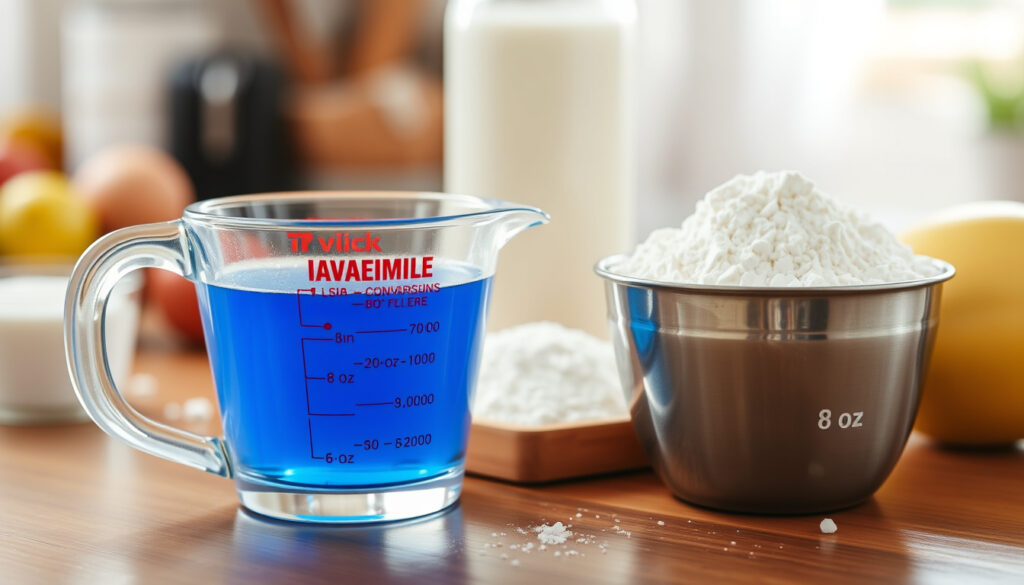
How Many Cups is 8 oz? Liquid, Dry & Ingredients Guide
If you’ve ever been halfway through a recipe and wondered whether “8 ounces” meant a cup of liquid or a cup of flour, you’re not alone. Kitchen measurements trip up almost everyone, and the confusion isn’t helped by the fact that one type of “cup” means something completely different from another. This guide cuts straight to the answer: 8 fluid ounces of water or milk equals exactly one US customary cup, but 8 ounces of flour? That’s closer to 1.8 cups—and the reason why matters every time you bake.
Liquid cups in 8 oz: 1 cup · US customary cup: 8 fl oz · Dry ounces per cup: Varies by ingredient · Water weight 8 oz: 1 cup · Flour volume for 8 oz: Approximately 1.8 cups
Quick snapshot
- 8 fl oz liquid = 1 US cup (Delightful Mom Food)
- 1 cup all-purpose flour ≈ 4.25 oz by weight (King Arthur Baking)
- Precise conversion without knowing specific flour brand or sifting method
- Regional variations in how “cup” is measured across recipes
- Conversion standards remain consistent since US adoption of customary units
- No major pending regulatory changes to measurement standards
- Understanding when to weigh vs. when to measure by volume
- Knowing which ingredients follow the liquid rule and which don’t
Here is how common ingredients compare when measured by weight versus volume:
| Ingredient | 8 oz equals approximately | Key variable |
|---|---|---|
| Water / Liquids | 1 US cup | Exact conversion |
| All-Purpose Flour | 1.8 cups | Density ~4.25–4.41 oz/cup |
| Granulated Sugar | 1.1 cups | Density ~7.25 oz/cup |
| Shredded Cheese | 2 cups | Loose packing vs. pressed |
| Bread Flour | 1.75 cups | Density ~4.48 oz/cup |
| Whole Wheat Flour | 1.75 cups | Density ~4.5 oz/cup |
Does 8 oz make 1 cup?
For liquids like water, milk, or oil, the answer is a clean yes. One US customary cup equals exactly 8 fluid ounces by volume (Shamrock Foods conversion chart). This standard is universal across liquid ingredients in US recipes—8 fluid ounces of any liquid that pours like water will fill one standard measuring cup.
Liquid volume basics
The US customary system defines the cup as exactly 8 fluid ounces, which equals about 237 milliliters (100 Days of Real Food). This conversion works every time because fluid ounces measure volume, not weight. Whether you’re measuring water, chicken broth, or vegetable oil, the relationship stays constant: pour until you hit the 8-fl-oz line, and you’ve filled one cup.
US customary standards
The 8-fl-oz-to-1-cup relationship is codified in commercial and culinary standards. According to food service conversion charts, 1 cup = 8 fl oz = 16 tablespoons = 237 ml for liquids (Shamrock Foods). This standard applies to all liquid ingredients when using a standard liquid measuring cup—the kind with the pour spout and markings on the side.
The implication: when a recipe calls for “8 oz” of a liquid ingredient with no qualifier, assume it’s asking for 1 cup. Your liquid measuring cup is the right tool.
Is 8 oz exactly 1 cup?
Yes, but only for liquids. The moment you switch to a dry ingredient, the numbers change—and this is where home cooks most often go wrong (Julie Blanner). Dry ounces measure weight, while cups measure volume. Since different ingredients have different densities, 8 ounces by weight rarely equals one cup by volume.
Fluid vs. weight ounces
The ounce comes in two distinct forms. A fluid ounce (fl oz) measures volume—the space a liquid takes up. An ounce (oz) by weight measures mass—the heaviness of a substance. Confusing these two is the single biggest source of kitchen measurement errors (Delightful Mom Food). One fluid ounce of water weighs about one ounce by weight, but that coincidence doesn’t extend to flour, sugar, or most other dry ingredients.
Common confusions
Recipes that say “8 ounces of flour” are almost always referring to weight, not volume. If you scoop that 8 ounces by volume (filling a dry measuring cup to the brim), you’ll end up with roughly 2 cups of flour—which is far more than intended. Experts consistently recommend weighing dry ingredients for accuracy in baking (Inch Calculator).
The catch: most home kitchens don’t have food scales, and many recipes assume volume measurements. Understanding the difference lets you estimate when you can’t weigh.
How many dry ounces are in a cup?
A standard US dry cup measures approximately 6.8 US dry ounces by volume, but this is an oversimplification. Dry measuring cups are designed to be filled and leveled—they measure volume, not weight. The actual weight of what’s in that cup depends entirely on the ingredient’s density (Delightful Mom Food).
Density differences
All-purpose flour weighs roughly 4.25 to 4.41 ounces per cup, depending on how it’s scooped and sifted (King Arthur Baking authority source). Granulated sugar, by contrast, weighs about 7.25 ounces per cup—nearly 75% heavier than flour by volume. This means one dry cup of sugar weighs more than one dry cup of flour, even though both fill the same-sized cup.
The same dry measuring cup holds different weights depending on what you put in it. A cup of flour is roughly half the weight of a cup of granulated sugar. This is why “8 ounces” in a recipe needs context: is it asking for weight or volume?
Ingredient examples
King Arthur Baking, a Tier 1 authority on baking ingredients, puts all-purpose flour at 120 grams (4.25 ounces) per cup (King Arthur Baking). Bread flour runs slightly heavier at 127 grams per cup due to higher protein content (Weekend Bakery). Cake flour is lighter still, at around 114 grams per cup, because it’s more finely milled and sifted.
The pattern: flour type, milling method, and packing density all shift the weight-per-cup figure. There is no universal “dry ounces per cup” that works for all ingredients.
How many cups is 8 oz of flour?
Eight ounces of all-purpose flour equals approximately 1.8 to 1.9 cups, depending on the specific conversion method used. Using King Arthur Baking’s weight of 4.25 oz per cup, 8 oz ÷ 4.25 = 1.88 cups (King Arthur Baking). Using Inch Calculator’s more precise figure of 4.409245 oz per cup, 8 oz ÷ 4.409245 = 1.81 cups (Inch Calculator).
Flour density
Flour density varies by type, brand, and how it’s measured. A cup of flour can weigh anywhere from 4.25 to 5.7 ounces depending on whether it’s been sifted, spooned into the cup, or scooped directly from the bag (GigaCalculator density converter). The difference between 1.4 cups and 1.9 cups for the same 8-ounce weight is significant in baking, where precision matters.
Baking is chemistry. Add 50% more flour than a recipe calls for, and your cookies spread differently, your bread rises poorly, your cake sinks. The density variables that seem minor in casual cooking become critical in baking—and they’re exactly why professionals insist on weighing ingredients.
Water, cheese, sugar comparisons
Eight ounces of water fills exactly one cup—no ambiguity. Eight ounces of shredded cheese, depending on how loosely it’s packed, measures roughly 2 cups—more than water because cheese is less dense and the shreds trap air (Delightful Mom Food kitchen guide). Eight ounces of granulated sugar equals about 1.1 cups, because sugar granules pack more densely than flour.
The trade-off: volume-only cooks accept inaccuracy; precision bakers invest in a kitchen scale. For most weeknight cooking, the difference is negligible. For bread, cakes, and pastries, it can mean the difference between success and failure.
How to measure 8 ounces without a scale?
Most home kitchens lack a food scale, and that’s fine—volume measurements work for most cooking. The key is using the right measuring cup for the right ingredient and understanding the trade-offs you’re making (Julie Blanner measurement guide).
Volume hacks
For liquids: use a liquid measuring cup with a pour spout. Fill to the 1-cup line, which corresponds to 8 fluid ounces (Shamrock Foods standard reference). This gives you an exact 1:1 conversion.
For dry ingredients: use dry measuring cups—those flat-topped nested metal or plastic scoops. Fill the cup, then level it off with a straight edge (like the back of a knife). Do not scoop and tap, which compacts flour and gives you less than the intended amount.
Household tools
A standard tablespoon holds approximately 0.5 fluid ounces. For liquid 8 oz, that’s 16 tablespoons. A dinner spoon holds about 2 tablespoons, so 8 tablespoons equals roughly 4 fluid ounces (Delightful Mom Food kitchen reference). These shortcuts work in a pinch but require steady hands and aren’t precision tools.
The practical approach for home cooks: when a recipe calls for “8 oz flour” without specifying cups, estimate between 1.75 and 2 cups of loosely-sifted, spooned-and-leveled flour. You won’t be exact, but you’ll be close enough for soups, sauces, and most savory dishes where exact flour weight matters less than in baking.
Volume measurements for dry ingredients sacrifice precision for convenience. If you’re making bread or cookies where hydration ratios drive the texture, the 15–20% variation from density differences can shift your results meaningfully. For those recipes, a $20 kitchen scale pays for itself in the first batch.
Steps: Measuring 8 ounces by volume
- Identify your ingredient type. Liquid? Use a liquid measuring cup. Dry? Use dry measuring cups.
- For liquids: Pour into a liquid measuring cup until the surface hits the 1-cup (8 fl oz) line. Check at eye level for accuracy.
- For dry goods: Spoon the ingredient into the dry cup until it heaps above the rim, then level with a flat edge. Do not shake or tap.
- Adjust for ingredient density. If the recipe specifies “8 oz” of a dry ingredient, know that you’ll need more than 1 cup by volume—roughly 1.8 cups for flour, 1.1 cups for sugar.
- When accuracy matters: Weigh the ingredient. 8 oz on a scale gives you the exact weight the recipe intended, regardless of how that ingredient packs in a cup.
What we know vs. what we don’t
Confirmed
- 8 fluid ounces of any liquid = 1 US cup (exact conversion per Shamrock Foods chart)
- 1 cup all-purpose flour ≈ 4.25–4.41 oz by weight (King Arthur Baking, Inch Calculator)
- 8 oz flour ≈ 1.8–1.9 cups (varies by measurement method)
- Flour weight per cup varies by sifting, packing, and brand
Uncertain
- Precise conversion without knowing specific flour brand
- Whether a scooped cup was packed or loosely filled
- Regional US vs. Canadian cup variations
What experts say
A cup of all-purpose flour weighs 120 grams or 4 1/4 ounces.
— King Arthur Baking (baking authority)
Experts often recommend measuring dry ingredients like flour by weight for accuracy. The same does not hold true for dry ingredients where 1 cup of a dry ingredient does not always equal to 8 ounces in weight.
— Julie Blanner (recipe developer)
For baking accuracy, use a food scale over volume measures.
— Inch Calculator (conversion expert)
1 cup = 8 fl oz = 16 tbsp = 237 ml for liquids.
— Shamrock Foods (food service conversion standard)
For home cooks, the lesson is clear: when a recipe specifies “8 ounces,” look at the ingredient. Liquids: pour to 1 cup. Flour: expect roughly 1.8 cups. Sugar: closer to 1.1 cups. The volume-to-weight mismatch isn’t a flaw in recipes—it’s a feature of using cups for both liquids and solids. Understanding which system you’re working in lets you adjust on the fly when scales aren’t available.
Related reading: 3 Meters to Feet Conversion: 9.8425 Feet or 9 Ft 10 In · 36.9 C to F: 36.9 Celsius to Fahrenheit Conversion (98.42°F)
8 oz equals 1 cup for most liquids precisely because how many ounces in a cup sets the US standard, though it stretches to around 1.8 cups for loosely packed flour.
Frequently asked questions
How much is 8 oz in ml?
Eight fluid ounces equals approximately 237 ml using the US customary cup standard (Shamrock Foods). A metric cup, used in Australia and Canada, is 250 ml.
What is 8 ounces in litres?
Eight fluid ounces equals approximately 0.237 litres (US measurement). One litre contains roughly 33.8 fluid ounces.
Is 2 cups 8 oz?
Yes, for liquids. Two US customary cups equal 16 fluid ounces, which is exactly 1 pound by weight for water. For dry ingredients, 2 cups can weigh significantly more or less than 8 ounces depending on the ingredient.
How many ounces is 2 cups?
Two US customary cups equals 16 fluid ounces for liquids (Delightful Mom Food). For dry ingredients, the weight varies by density—2 cups of flour weighs roughly 8.5–8.8 oz, while 2 cups of sugar weighs about 14.5 oz.
Are 8 oz 2 cups?
For liquids, yes: 8 fl oz = 1 cup, so 8 fl oz is not 2 cups—it’s half of 2 cups. The confusion arises because “8 oz” by weight of a dry ingredient doesn’t translate to 2 cups of that ingredient in most cases.
Is 8 ounces enough for 2 cups?
Eight fluid ounces is only 1 cup by volume, not 2 cups. You would need 16 fluid ounces to equal 2 cups. However, 8 ounces by weight of a light, fluffy ingredient like shredded cheese can fill close to 2 cups by volume.
What kitchen conversions are important?
The most critical conversions for home cooks are: fluid ounces (volume) vs. ounces (weight), US cup (237 ml) vs. metric cup (250 ml), and liquid measuring cups vs. dry measuring cups. Mastering these distinctions prevents the most common kitchen measurement errors.
More related posts
 Does Dose For Your Liver Work – Evidence And Consumer Data
 Soft Summer Color Palette: Colors, Hair & Makeup Guide
 How to Schedule a Text on iPhone: Send Later Guide
 St. Louis Cardinals vs Pittsburgh Pirates Match Player Stats – 2024 Box Scores and Key Highlights
 The Legend of Korra: LGBTQ+ Rep, Disability, and Where to Watch
 Signs of Low Blood Sugar: Symptoms, Causes & Treatment
 Leanne Morgan Movies and TV Shows: Complete List (2025)
 January 1 California Pet Law: AB 519 & Cat Declaw Ban