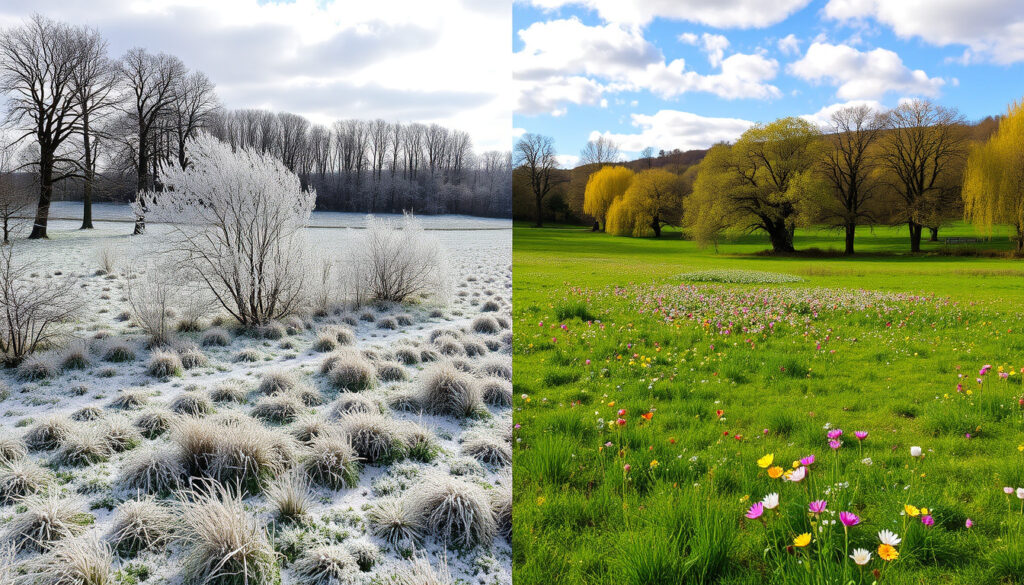
What Season Are We In? Current Season Dates for UK & USA
Ever found yourself asking, “What season are we in?” only to get two different answers depending on who you ask? That’s because there are actually two systems for defining the seasons — meteorological and astronomical — and they don’t always agree. In the Northern Hemisphere as of May 2025, both systems point to spring, but their start dates differ by nearly three weeks.
Northern Hemisphere spring start (meteorological): March 1 ·
Northern Hemisphere summer start (meteorological): June 1 ·
UK spring 2025 start (astronomical): March 20 ·
Seasons per year in mid-latitudes: 4
Quick snapshot
- Meteorological: March, April, May (National Physical Laboratory (UK measurement authority))
- Astronomical 2025: March 20 to June 20 (timeanddate.com (global calendar reference))
- Meteorological: June, July, August (National Physical Laboratory (UK measurement authority))
- Astronomical 2025: June 20 to September 22 (LBC (UK radio weather))
- Meteorological: September, October, November (Woodland Trust Nature’s Calendar (UK phenology tracker))
- Astronomical 2025: September 22 to December 21 (Calendarr (UK seasonal calendar))
- Meteorological: December, January, February (National Physical Laboratory (UK measurement authority))
- Astronomical 2025: December 21 to March 20, 2026 (BBC Bitesize (UK educational service))
Here is a quick reference for the current season details.
| Fact | Value |
|---|---|
| Number of seasons in mid-latitudes | 4 |
| Meteorological spring start (Northern Hemisphere) | March 1 |
| Astronomical spring start 2025 (Northern Hemisphere) | March 20 |
| Current season (May 2025, Northern Hemisphere) | Spring |
What are the 4 seasons and their months?
Meteorological season months
- Spring: March, April, May — fixed by the Calendarr (UK seasonal calendar) as the three-month block beginning 1 March.
- Summer: June, July, August.
- Autumn: September, October, November.
- Winter: December, January, February.
The meteorological system, used by weather services like the Met Office (UK national weather authority), divides the year into consistent three-month blocks. This makes it easier to compare climate statistics from one year to the next — April 2024’s rainfall with April 2025’s, for instance — because the calendar boundaries never shift.
Astronomical season dates
- Spring: From the vernal equinox (around March 20) to the summer solstice (around June 20).
- Summer: From the summer solstice to the autumnal equinox (around September 22).
- Autumn: From the autumnal equinox to the winter solstice (around December 21).
- Winter: From the winter solstice to the vernal equinox.
Astronomical seasons are tied to Earth’s tilt and orbit around the Sun. The LBC (UK radio weather) lists the 2025 equinoxes and solstices — the March equinox on March 20, the June solstice on June 20, the September equinox on September 22, and the December solstice on December 21. These dates shift by a day or two each year, which is why one system says spring starts March 1 and another says March 20.
Meteorological seasons sacrifice astronomical precision for calendar consistency. For a weather forecaster comparing March rainfall across decades, the meteorological system is the only practical choice. For someone planning a midsummer celebration tied to the longest day, only the solstice date matters.
The implication: when you ask “what season are we in,” the answer depends on whether you want a fixed calendar answer or one tied to the Sun’s position. Both are correct — they just serve different needs.
What season are we in currently in the UK?
Current UK season based on meteorological calendar
- As of early May 2025, the UK is in spring under the meteorological system (Met Office (UK national weather authority)).
- Meteorological spring runs from March 1 to May 31.
- The next change comes June 1, when meteorological summer begins.
Current UK season based on astronomical calendar
- As of early May 2025, the UK is also in spring under the astronomical system (Calendarr (UK seasonal calendar)).
- Astronomical spring 2025 began on March 20 (vernal equinox).
- The next change comes June 20, when the summer solstice marks astronomical summer’s start.
The Met Office (UK national weather authority) explains that the UK has four seasons because the Northern Hemisphere tilts toward and away from the Sun as it orbits. Both systems agree on “spring” right now — but they disagree on when it started by nearly three weeks.
The real split shows up at the transition. A UK gardener following the astronomical calendar might wait until June 21 to call it summer. A meteorologist will start the summer season on June 1. Neither is wrong — but their timelines for “when summer starts” differ by 20 days.
What this means: for day-to-day life, the difference rarely matters. But for anyone planning seasonal activities — planting, tourism, heating bills — knowing which system you’re using changes your timeline.
When do seasons start and end?
Meteorological season start and end dates
Four fixed blocks with no variation:
| Season | Start | End |
|---|---|---|
| Spring | March 1 | May 31 |
| Summer | June 1 | August 31 |
| Autumn | September 1 | November 30 |
| Winter | December 1 | February 28/29 |
The Calendarr (UK seasonal calendar) confirms these fixed dates as the standard for climatological comparisons. The Woodland Trust Nature’s Calendar (UK phenology tracker) likewise uses the meteorological system for its seasonal records, with autumn 2025 running September 1 to November 30.
Astronomical season start and end dates
These shift each year by a day or two based on Earth’s orbit:
| Season | 2025 Start | 2025 End |
|---|---|---|
| Spring | March 20 | June 20 |
| Summer | June 20 | September 22 |
| Autumn | September 22 | December 21 |
| Winter | December 21 | March 20, 2026 |
The Daily Line (UK seasonal blog) publishes these annual dates, along with the exact UTC times of each equinox and solstice. For 2025, the September equinox falls on September 22 at 19:19 UTC, and the December solstice on December 21.
The pattern: the astronomical system’s drift means that the same date — March 20, for instance — can be winter in one year and spring the next, depending on when the equinox falls. The meteorological system eliminates that drift entirely by fixing the calendar.
What season is it in America now?
Current US season
- As of early May 2025, the United States is in spring under the meteorological system — the same as the UK (NOAA (US climate authority)).
- The US National Weather Service, using data from timeanddate.com (global calendar reference), lists the March 20 equinox as the astronomical start of spring for 2025.
- Meteorological spring in the USA: March 1 to May 31.
US vs. UK season differences
| Aspect | USA | UK |
|---|---|---|
| Primary system in general use | Meteorological widely used | Both systems recognized; astronomical often used in public calendars |
| Spring meteorological | March 1 – May 31 | March 1 – May 31 |
| Spring astronomical 2025 | March 20 – June 20 | March 20 – June 20 |
| Overall seasons | 4 (spring, summer, fall, winter) | 4 (spring, summer, autumn, winter) |
Both nations experience the same astronomical event — the March equinox on the same day — and both use the same meteorological month blocks. A traveler flying from London to New York on May 1 is in spring at both ends.
Why this matters: the “dual answer” problem for “what season are we in” is not a UK vs. USA issue. It’s a meteorological vs. astronomical issue that plays out identically in both countries. The only meaningful difference is which system appears in government websites and school calendars — and even there, both countries mix the two.
“The UK has four seasons because the northern hemisphere tilts toward and away from the Sun through the year.”
“Meteorological seasons divide the year into fixed three-month blocks: spring starts on 1 March, summer on 1 June, autumn on 1 September, and winter on 1 December.”
— National Physical Laboratory (UK measurement authority)
“For 2025, the autumnal equinox occurs on 22 September at 19:19 UTC, marking the astronomical start of autumn.”
“In the USA, meteorological winter in 2025 runs from 1 December 2025 to 28 February 2026.”
The question “what season are we in” has a straightforward answer — spring, as of May 2025 in the Northern Hemisphere. But the system behind that answer matters more than most people realize. The choice between meteorological and astronomical definitions changes the start and end dates of every season, and for anyone tracking climate patterns, planning agriculture, or simply wanting a consistent calendar, that choice has real consequences. For UK residents and US readers alike, the implication is clear: know which system you’re using, or accept that your “first day of summer” might be someone else’s “still spring.”
Frequently asked questions
What season are we in today?
As of May 2025 in the Northern Hemisphere (UK and USA), the current season is spring under both meteorological and astronomical definitions. Meteorological spring runs March 1 to May 31. Astronomical spring began March 20 and ends June 20.
What season is it in the Southern Hemisphere right now?
Southern Hemisphere seasons are opposite. While the Northern Hemisphere is in spring (May 2025), the Southern Hemisphere is in autumn. Meteorological autumn there runs March 1 to May 31. The NOAA (US climate authority) confirms the Southern Hemisphere’s meteorological seasons start on June 1 for winter.
Why are there two different systems for season start dates?
Meteorological seasons use fixed calendar months for consistent climate comparisons. Astronomical seasons are tied to Earth’s tilt and orbit around the Sun, with start dates determined by equinoxes and solstices. Both serve different purposes — weather statistics vs. celestial alignment.
What are the exact dates for each season in 2025?
Meteorological dates are fixed: spring March 1–May 31, summer June 1–August 31, autumn September 1–November 30, winter December 1–February 28. Astronomical dates for 2025: spring March 20–June 20, summer June 20–September 22, autumn September 22–December 21, winter December 21–March 20, 2026 (timeanddate.com (global calendar reference)).
Does the UK use meteorological or astronomical seasons?
The UK uses both. The Met Office (UK national weather authority) provides guidance on both systems. The astronomical definition is often used in public calendars and official UK government references, while meteorological dates are common in weather reporting and climate data.
Is spring always March to May everywhere?
No. Spring runs March to May only in the Northern Hemisphere under the meteorological system. Southern Hemisphere spring is September to November. In tropical regions near the equator, seasons are often defined by rainfall (wet/dry) rather than temperature, and some regions recognize six seasons instead of four.
What season is November in the Northern Hemisphere?
Under the meteorological system, November is in autumn (autumn runs September 1 to November 30). Under the astronomical system, November falls entirely within autumn, which runs from the September equinox (September 22 in 2025) to the December solstice (December 21).
More related posts
 Symptoms of a Stroke: Warning Signs, FAST Test, and 4-Hour Rule
 Netflix 24 Hour Customer Service Number – Official Guide & Chat Options
 Synchrony Bank Phone Number: Customer Service & Hours (2025)
 120 kg to lbs: Convert 120 Kilograms to Pounds
 New York Giants vs Las Vegas Raiders: Player Stats 2025
 Shows in Las Vegas 2026: Best Shows, Budget Tips & More
 Timberwolves vs Memphis Grizzlies Match Player Stats – Box Score and Top Performers