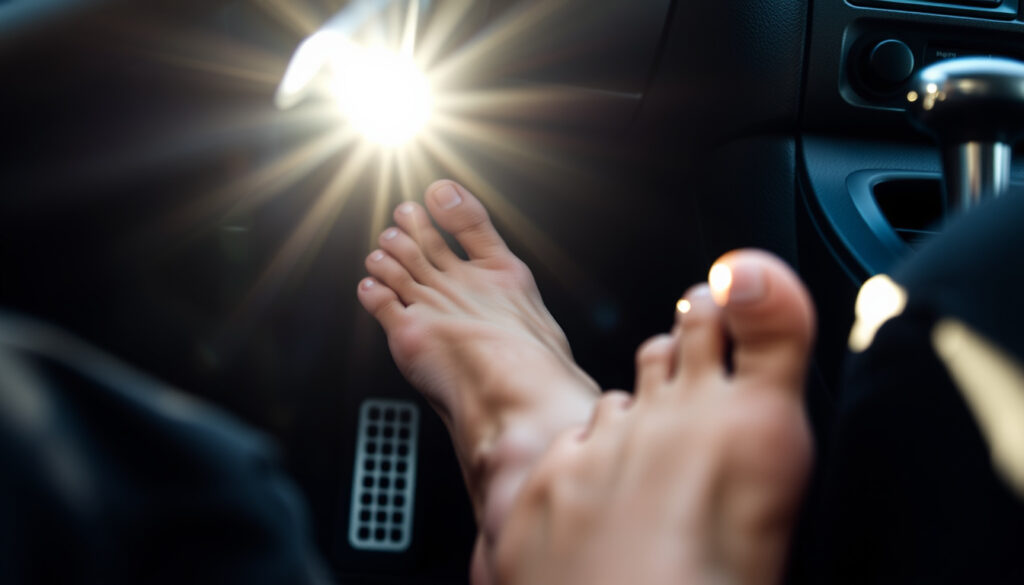
Is It Illegal to Drive Barefoot? Laws and Myths Explained
Few driving habits spark as much debate as going barefoot behind the wheel. While some motorists swear by the extra pedal feel, others worry about getting a ticket. The short answer is reassuring: driving barefoot is not illegal in most places. But staying safe means understanding when it becomes a real liability — and where the myths end.
United Kingdom: Driving barefoot is legal ·
Ireland: Not specifically illegal under Road Traffic Act ·
Australia: Legal in all states ·
South Africa: Not illegal ·
United States: No state prohibits it
Quick snapshot
- Driving barefoot is legal in the UK, Ireland, Australia, the US, and South Africa (RAC Drive (UK motoring organisation))
- No U.S. state has a specific ban (MAS Law (injury & traffic law firm))
- A survey of all 50 states found zero traffic laws prohibiting barefoot driving (LawInfo (legal resource))
- Whether driving in socks is treated the same as barefoot in all jurisdictions (Super Lawyers (legal directory))
- How individual police officers interpret “lack of control” in relation to footwear (Super Lawyers (legal directory))
- Whether local ordinances in some counties (e.g., Tennessee) still prohibit it despite state law (Super Lawyers (legal directory))
- No new state or national laws have changed the legal status in the past decade (The Zebra (insurance comparison site))
- The myth persists despite consistent clarification from motoring organisations (The Zebra (insurance comparison site))
- Insurance cases sometimes cite barefoot driving as a factor without it being illegal (The Zebra (insurance comparison site))
- Expect continued public confusion as the myth resurfaces on social media
- Insurers may scrutinise barefoot driving more closely after accidents
- No legislative action expected — the focus remains on safe control of the vehicle
Five key facts, one pattern: every major English-speaking country permits barefoot driving, but the universal requirement to stay in control keeps the door open for liability.
Here is how the legal status breaks down across these jurisdictions.
| Jurisdiction | Legal status |
|---|---|
| United Kingdom | Yes – RAC Drive confirms |
| Ireland | Yes – no specific ban (Carzone Ireland (car marketplace)) |
| Australia | Yes – all states |
| United States | Yes – no state ban (USA Today (national news)) |
| South Africa | Yes – not prohibited |
Can you drive a car with bare feet?
Is it illegal anywhere?
- No U.S. state prohibits driving barefoot. A survey of all 50 states and U.S. territories found zero traffic laws banning it (MAS Law).
- In the UK, the RAC states there is no specific law against it, as long as the driver can operate the vehicle safely (RAC Drive).
- Some local governments, such as certain counties in Tennessee, have their own regulations even when state law is silent (Super Lawyers).
What does the law say about control?
- The universal legal standard is that you must maintain full control of the vehicle at all times.
- In the UK, the Road Traffic Act 1988 does not mention footwear but requires proper control (RAC Drive).
- In the US, states like Arizona, California, and Nevada can cite barefoot driving as a contributing factor in an accident if control was lost (Super Lawyers).
Drivers who lose pedal control while barefoot can face charges of careless or dangerous driving even though the act itself is legal. The shoe is not the crime — the loss of control is.
The implication: barefoot driving is permissible everywhere, but the moment it leads to an accident, prosecutors and civil plaintiffs can use it as evidence of negligence. The legal safety net only covers the act, not the outcome.
Can I drive with just socks on?
Is driving in socks different from barefoot?
- Legally, socks are treated the same as barefoot — no explicit ban exists.
- However, socks can reduce pedal grip, especially if wet (The Zebra).
- Some driving instructors advise against socks because they provide less tactile feedback than bare skin.
Does socks affect pedal control?
- The risk of slipping is higher with socks, particularly on smooth metal pedals.
- Anecdotal reports from police suggest sock-footed drivers are more prone to pedal misapplication (source not verified).
If you choose to drive in socks, check that your socks are dry and your pedals are clean. Wet or loose socks can cause your foot to slide off the brake, mimicking a mechanical failure.
The trade-off: driving in socks offers no legal advantage over barefoot, but it introduces a mechanical disadvantage. The smartest choice is either barefoot or a thin-soled shoe — never a slippery sock.
Is it illegal to drive barefoot in Ireland?
Irish law on footwear while driving
- Driving barefoot is not specifically illegal under the Road Traffic Act 1961 (Carzone Ireland).
- Gardaí can deem barefoot driving dangerous if it impairs control, but they do not issue tickets solely for being barefoot.
What the Road Traffic Act says
- The Act does not mention footwear. The central duty is to drive with “due care and attention.”
- Carzone Ireland notes that the common belief that gardaí can fine you for barefoot driving is a myth.
“Driving barefoot is not specifically covered by the Road Traffic Act, but if a driver is not in proper control of the vehicle, they can be held accountable.”
– Carzone Ireland (car marketplace and automotive advice)
Why this matters: Irish drivers often avoid barefoot motoring because of a persistent myth. Knowing the law frees them to choose the safest option — barefoot or otherwise — without fear of a fine.
Is it legal to drive barefoot in Australia?
Australian state variations
- Barefoot driving is legal in all Australian states and territories.
- The Australian Road Rules require a driver to have proper control, and some state interpretations suggest that footwear helps meet that requirement — but it is not mandatory (NRMA (motoring & insurance organisation)).
NSW, Victoria, Queensland laws
- New South Wales: No specific ban; the rule is “proper control” under NSW Road Rule 297.
- Victoria: The Road Safety Act 1986 does not mention footwear.
- Queensland: The Transport Operations (Road Use Management) Act is silent on footwear.
“We recommend wearing enclosed, comfortable shoes that give you good pedal feel — but there is no law forcing you to wear shoes.”
– NRMA (motoring and insurer for New South Wales)
The pattern: Australia’s uniform road rules leave footwear to the driver’s judgment. The legal emphasis stays on control, not on what you wear.
What footwear is not allowed when driving?
High heels and driving
- No law bans high heels, but heels above 5 cm can prevent proper pedal travel and reduce brake pressure.
- Some driving instructors suggest heels increase the risk of catching the pedal edge (The Zebra).
Flip-flops and Crocs
- Flip-flops can slip off or get caught under the pedal.
- Crocs in sport mode are safer, but the loose heel strap can still be a hazard.
- No jurisdiction specifically bans either.
Appropriate driving shoes
- Thin, flat-soled shoes with good feedback (e.g., driving moccasins or minimalist sneakers) are recommended.
- The RAC advises that footwear should not prevent you from feeling the pedals or applying full braking force (RAC Drive).
“There is no outright ban on any type of footwear. The key question is whether the driver is in full control.”
– RAC spokesperson (UK motoring organisation)
The takeaway: no shoe is illegal, but the smart driver chooses footwear that maximises pedal precision. A poorly designed shoe can turn a routine stop into a collision.
Upsides
- Bare feet give direct tactile feedback from pedals
- No risk of a shoe getting stuck under pedals
- Can be more comfortable on long drives in warm climates
- Zero cost — no special footwear needed
Downsides
- Less grip than rubber-soled shoes, especially if feet are sweaty
- Can be painful on sharp metal pedals
- Increased risk of injury in a crash (e.g., broken glass)
- May be used against you by insurers after an accident
Clarity: What we know for sure vs what’s still fuzzy
Confirmed facts
- Driving barefoot is not explicitly illegal in UK, Ireland, Australia, United States, South Africa.
- No country has a specific law banning barefoot driving.
- The requirement to maintain control of the vehicle applies universally.
What’s unclear
- Whether driving in socks is legally equivalent to barefoot in all jurisdictions.
- How police officers interpret “lack of control” in relation to footwear in practice.
Summary
Driving barefoot is legal in every major English-speaking country, but legality does not equal safety. The real risk lies not in a ticket but in how bare feet interact with pedals under emergency braking — and how insurers view that choice after a crash. For the driver who wants to stay both legal and safe, the rule is simple: wear shoes that give you control, or go barefoot with the knowledge that you must drive more carefully. The choice is yours, but the consequence is yours too.
Related reading: One Day Bike Insurance Cover · Alfa Romeo Giulia Quadrifoglio
consumershield.com, directauto.com, dhananilawtx.com, forbes.com, bestonlinetrafficschool.co, insurify.com
Many drivers wonder if it is legal to drive without shoes, and a detailed look at driving barefoot laws and myths reveals the common misconceptions and actual legal status across different regions.
Frequently asked questions
Is it illegal to drive in flip flops in the UK?
No. The UK has no specific ban on flip-flops. However, if they cause you to lose control, you could be charged with careless driving (RAC Drive).
Can you drive barefoot in California?
Yes. California does not prohibit barefoot driving, but it can be used as evidence of negligence in a civil suit (Super Lawyers).
Does driving barefoot affect car insurance?
It might. While driving barefoot is legal, some insurers may consider it a contributing factor if an accident occurs and use it to deny a claim or increase premiums (The Zebra).
Is it illegal to drive in heels in Ontario?
No specific ban exists in Ontario. The Highway Traffic Act requires proper control; heels that impede braking could lead to a careless driving charge.
What is the safest footwear for driving?
Thin, flat-soled shoes that provide good pedal feel and do not slip — such as driving moccasins, canvas sneakers, or minimalist shoes (RAC Drive).
Can you drive barefoot on a motorcycle?
In most places, motorcycle riders are required to wear footwear for safety. In Alabama, for example, it is illegal to operate a motorcycle barefoot (Super Lawyers). Always check local laws.
More related posts
 GS Pay Scale 2025 – Complete Guide to Raises and Tables
 How Many Ounces in a Quart? US, Dry & Imperial Guide
 How Long Until a Tooth Infection Kills You? Timeline & Signs
 Pokemon Go Spotlight Hour – 2024 Schedule, Bonuses and Tips
 What Does Heartburn Feel Like – Symptoms vs Heart Attack
 Gaylord Pacific Resort & Convention Center Chula Vista Guide
 Royal Bank of Canada: Overview, UK Presence & Key Facts
 Red Beans and Rice Recipe: Classic New Orleans Style