Chlamydia Bumps on Tongue: Symptoms, Causes, and Treatment
Few things are more unsettling than noticing a bump on your tongue and wondering what it might mean. If you’ve had unprotected oral sex, you might worry about chlamydia—but oral chlamydia is often symptom-free, and bumps on the tongue are a rare presentation. This guide separates fact from fear, helping you understand what oral chlamydia looks like, how it’s diagnosed, and when to see a doctor.
Most reported bacterial STI in the US: Chlamydia is the most reported bacterial sexually transmitted infection in the United States. ·
Annual US cases (2022): Approximately 2.5 million cases of chlamydia were reported in 2022. ·
Asymptomatic oral infections: Up to 90% of people with oral chlamydia have no symptoms. ·
Bumps on tongue rarity: Chlamydia bumps on the tongue are a rare manifestation of oral chlamydia.
Quick snapshot
- Infection with Chlamydia trachomatis bacteria (CDC STI Treatment Guidelines)
- Transmission via oral sex with an infected partner (CDC About Chlamydia)
- Can occur without symptoms in the genital area (CDC About Chlamydia)
- Rare: bumps on tongue (white/red spots) (CDC STI Treatment Guidelines)
- Sore throat, redness in the mouth (CDC About Chlamydia)
- Often completely asymptomatic (CDC About Chlamydia)
- Oral swab or urine test (CDC STI Treatment Guidelines)
- Physical examination by a healthcare provider (CDC STI Treatment Guidelines)
- Testing for other STIs recommended (CDC About Syphilis)
- Antibiotics (azithromycin or doxycycline) (CDC STI Treatment Guidelines)
- Abstain from sex until infection clears (CDC STI Treatment Guidelines)
- Partner treatment to prevent reinfection (CDC STI Treatment Guidelines)
Five facts about oral chlamydia, compressed into a single table:
| Category | Detail |
|---|---|
| Causative agent | Chlamydia trachomatis bacterium |
| Transmission | Oral-genital contact with an infected person (CDC About Chlamydia) |
| Asymptomatic rate | Up to 90% of oral cases (CDC STI Treatment Guidelines) |
| Treatment | Antibiotics (azithromycin or doxycycline) (CDC STI Treatment Guidelines) |
| Prevention | Condoms and dental dams during oral sex (CDC About Chlamydia) |
The implication: these five points give the essential baseline for anyone assessing their risk or symptoms.
Can chlamydia cause tongue bumps?
How does Chlamydia trachomatis infect the mouth?
- Oral sex without a condom or dental dam with an infected partner can transfer the bacteria to the throat and mouth (CDC About Chlamydia).
- The CDC STI Treatment Guidelines note that the clinical significance of oropharyngeal chlamydia is unclear and prevalence is low, even among high‑risk populations.
How often do tongue bumps occur with oral chlamydia?
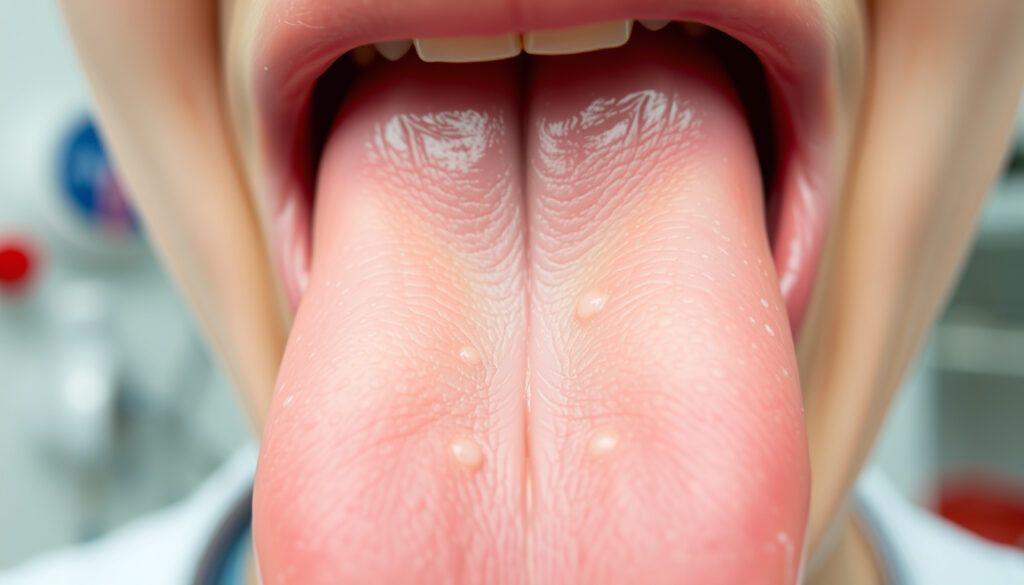
Bumps on the tongue are a rare symptom of oral chlamydia. The CDC About Chlamydia states that chlamydia often has no symptoms, and when they do occur they are primarily genital or urinary—not oral lesions. A 2026 review in PMC/NIH (Oral Manifestations of Secondary Syphilis) found that oral lesions are far more characteristic of syphilis than chlamydia.
The pattern: bumps on the tongue are not a classic chlamydia sign. If you see them, syphilis or HPV should also be on your radar.
Because oral chlamydia is overwhelmingly asymptomatic, a tongue bump is far more likely to be caused by syphilis (chancre or mucous patch) or HPV than by Chlamydia trachomatis. Relying on visual self‑diagnosis leads to missed or delayed treatment.
What does chlamydia look like on the tongue?
Appearance and texture of chlamydia bumps
According to the CDC About Chlamydia, oral chlamydia does not have a characteristic “look” on the tongue. When bumps do appear, they are described as small, white or red spots that may be painless or slightly sore. They can easily be mistaken for canker sores, syphilis chancres, or HPV lesions.
Where on the tongue do bumps typically appear?
There is no typical location for chlamydia bumps because the infection is usually in the throat (oropharynx) rather than on the tongue itself. The CDC STI Treatment Guidelines emphasize that chlamydia detected at the throat rarely produces visible lesions.
How to differentiate chlamydia bumps from other oral lesions
| Condition | Typical lesions | Key difference |
|---|---|---|
| Oral chlamydia | Rare small white/red spots, often painless | Almost always asymptomatic; lesions are the exception (CDC STI Treatment Guidelines) |
| Oral syphilis (primary) | Single smooth chancre on tongue, lips, or gums | Usually a single firm, painless sore (Cleveland Clinic: Syphilis) |
| Oral HPV | Small, hard, painless bumps (papillomas), often clustered | Growths may be white, pink, or red; may appear anywhere in mouth (Medical News Today: HPV in the mouth) |
| Secondary syphilis | Mucous patches (white/pink lesions) on tongue, cheeks, palate | Occurs in ~30% of cases; often accompanied by sore throat, fever, lymphadenopathy (PMC/NIH: Oral Manifestations of Secondary Syphilis) |
The implication: without laboratory testing, differentiating chlamydia from syphilis or HPV based on appearance alone is unreliable.
What are 5 signs of chlamydia?
Common symptoms of genital chlamydia
- Abnormal discharge from the penis or vagina
- Burning sensation during urination
- Pain or swelling in the testicles (men) (CDC About Chlamydia)
Specific signs of oral chlamydia
- Sore throat that persists
- Redness or mild swelling in the throat
- Rarely, small bumps or spots on the tongue or inside the cheeks (CDC About Chlamydia)
When to suspect chlamydia beyond bumps
The CDC About Chlamydia says most cases have no symptoms. If you have had unprotected oral sex and develop any of the above, testing is the only reliable way to know.
Because oral chlamydia is usually silent, a tongue bump alone is a weak signal. The strongest clues come from your sexual history and a lab test, not a mirror.
How can I tell if I have oral chlamydia?
Self‑examination steps for oral symptoms
- Use a bright light and mirror to inspect your tongue, gums, inside cheeks, and the roof of your mouth.
- Look for white or red spots, sores, or unusual bumps.
- Note any sore throat, difficulty swallowing, or swollen lymph nodes in the neck.
Self‑examination can detect visible lesions but cannot confirm chlamydia. CDC STI Treatment Guidelines state that only a lab test—either an oral swab or a urine test—can diagnose the infection.
At‑home testing options and limitations
Some at‑home STI test kits include oral swabs for chlamydia, but they are less sensitive than clinician‑collected samples. The CDC STI Treatment Guidelines recommend a nucleic acid amplification test (NAAT) performed by a healthcare provider for the most accurate result.
When to see a healthcare provider
See a provider if you have had unprotected oral sex and notice any persistent oral symptoms, or if you simply want peace of mind. Testing for other STIs such as syphilis, HIV, and HPV is also recommended because co‑infections are common.
Delaying diagnosis of syphilis or HPV carries risks of progression to secondary stages or cancer, whereas chlamydia is curable with a short course of antibiotics.
Can you catch chlamydia on your tongue?
Transmission routes for oral chlamydia
Yes. The CDC About Chlamydia confirms that chlamydia can be transmitted through oral sex without a condom with an infected partner. The bacteria can infect the throat and, rarely, the tongue.
Risk factors for oral infection
- Having multiple sexual partners
- Not using condoms or dental dams during oral sex
- Having a partner with a known chlamydia infection (CDC About Chlamydia)
Prevention strategies
- Use latex condoms for oral sex on the penis.
- Use dental dams for oral sex on the vulva or anus.
- Get regular STI testing if you are sexually active with new or multiple partners.
What this means: oral chlamydia is preventable with the same barrier methods that protect against genital infection. The catch is that many people do not use protection for oral sex, assuming the risk is lower—but the risk is real.
Confirmed facts vs. what’s still unclear
Confirmed facts
- Chlamydia can infect the oral cavity (CDC STI Treatment Guidelines).
- Bumps on the tongue are a rare but documented symptom (CDC About Chlamydia).
- Oral chlamydia is treated with the same antibiotics as genital infections (CDC STI Treatment Guidelines).
- Syphilis chancres are far more common on the tongue than chlamydia bumps (Cleveland Clinic: Syphilis).
What’s unclear
- The exact appearance of chlamydia bumps varies widely between individuals.
- It is unclear how often tongue bumps appear compared to other oral symptoms.
- Differentiating chlamydia bumps from syphilis or HPV bumps may require a professional examination.
What experts say
“Chlamydia often has no symptoms, but when it does, they can include discharge, burning, and pain. Oral chlamydia is usually asymptomatic, so testing is key after exposure.”
“Most people with oropharyngeal Chlamydia trachomatis do not have symptoms. The clinical significance of these infections is unclear, and prevalence is low even among high‑risk populations.”
— CDC (STI Treatment Guidelines)
“Primary syphilis sores can occur on the genitals, rectum, tongue, or lips. They are usually firm, round, and painless.”
“Oral HPV infections usually have no symptoms. When present, growths may be white, pink, or red, and can appear on the tongue, soft palate, or lips.”
For anyone with a new or unusual bump on the tongue after unprotected oral sex, the choice is clear: get tested for chlamydia, syphilis, and HPV. A simple swab or urine test can rule out chlamydia, and early treatment with antibiotics cures it—but misidentifying a syphilis chancre or HPV lesion can delay proper care. Your tongue is not a reliable diagnostic tool; a healthcare provider is.
Related reading: How to Treat Swollen Lymph Nodes in Neck Naturally · Child Rash: When to Worry – Pediatric Triage Guide
stdcheck.com, healthline.com, vitality-dental.co.uk, mouthhealthy.org, mouthhealthy.org
Frequently asked questions
Can chlamydia go away without treatment?
No. Chlamydia requires antibiotic treatment. Without it, the infection can persist and cause complications such as pelvic inflammatory disease or infertility (CDC STI Treatment Guidelines).
How long does oral chlamydia last if untreated?
Chlamydia can remain in the body indefinitely if not treated. It does not resolve on its own, though symptoms may come and go.
Is oral chlamydia contagious even without symptoms?
Yes. The CDC About Chlamydia states that people can spread chlamydia even if they have no symptoms.
Can you get chlamydia in the throat without having oral sex?
Oral chlamydia is almost exclusively transmitted through oral‑genital contact. It is not spread through kissing or sharing drinks.
What happens if oral chlamydia is left untreated?
Untreated oral chlamydia may spread to other parts of the body, and you can continue to transmit it to partners. It may also increase the risk of HIV acquisition.
Can oral chlamydia turn into genital chlamydia?
No, the infection stays at the site of exposure. However, if you have oral chlamydia and then perform oral sex on a partner, you can infect their genitals.
How soon after exposure can oral chlamydia be detected?
Testing is most reliable 1–2 weeks after exposure. The CDC STI Treatment Guidelines recommend NAAT testing for the best accuracy.
Are there home remedies for chlamydia bumps on the tongue?
No. Chlamydia is a bacterial infection that must be treated with prescription antibiotics. Home remedies cannot cure it.
More related posts
 Imagine Me & You (2005): Where to Watch, Cast & LGBTQ+ Legacy
 Feast of the Seven Fishes: Traditions, Menu & Meaning
 Epic Games Free Games: Complete Guide to Weekly Freebies (2025)
 How to Open a Roth IRA – 2025 Eligibility and Steps Guide
 How Much Is a Ton? Short Ton, Long Ton, Metric Ton Explained
 Weighted Vest for Walking: Benefits, Weight Guide & Tips
 Fairly OddParents: A New Wish – Timmy Absence & Season 2
 Hamnet (2025 film): True story, cast, and release date