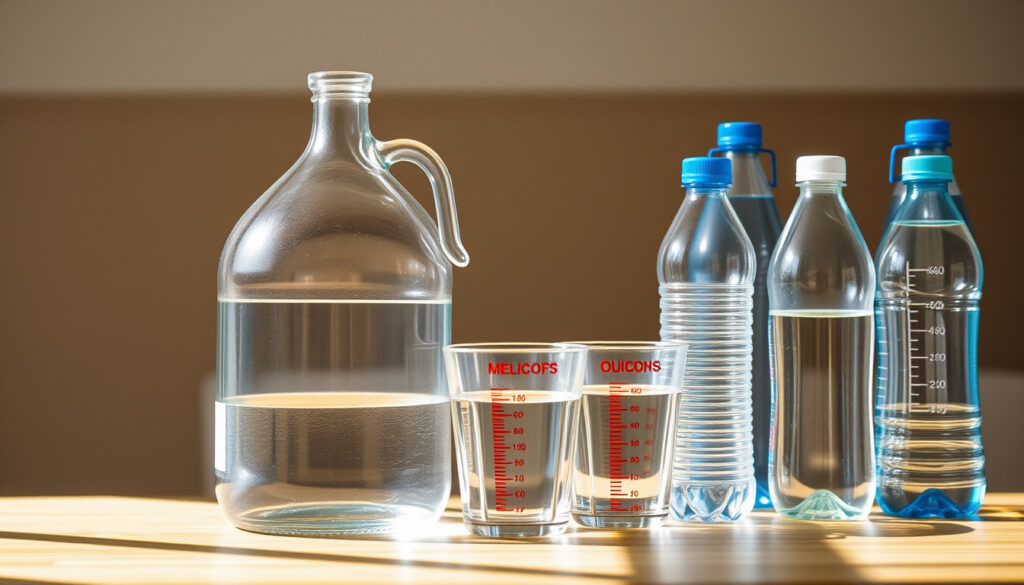
1 Gallon to Oz: Exact Conversion & Daily Water Intake Guide
You’ve seen the challenge: “drink a gallon of water a day.” But when you reach for a measuring cup, that number means different things depending on where you live. One U.S. gallon equals exactly 128 fluid ounces, while the Imperial gallon used in the United Kingdom packs 160 fluid ounces—a difference that can throw off everything from a recipe to a hydration routine.
1 US gallon: 128 fluid ounces ·
1 UK gallon: 160 fluid ounces ·
64 fluid ounces: 0.5 US gallon ·
32 fluid ounces: 0.25 US gallon ·
Daily water (men): 3.7 L (125 oz) ·
Daily water (women): 2.7 L (91 oz)
Quick snapshot
- 1 US gallon = 128 US fluid ounces (NIST Office of Weights and Measures)
- 1 UK gallon = 160 UK fluid ounces (UK Government)
- 64 fl oz = 0.5 US gallons (NIST)
- Exact individual water needs vary widely by activity, climate, and health (Mayo Clinic)
- Optimal hydration markers beyond thirst are still debated (NHS)
- U.S. gallon defined by Congress in 1832 based on the wine gallon of 231 cubic inches (NIST)
- Imperial gallon standardized in 1824 by the British Weights and Measures Act (UK Government)
- “Drink a gallon a day” advice gained traction in fitness culture around the 2010s, often misinterpreting the conversion (NIST)
- Focus shifts to personalized hydration based on body weight, sweat rate, and urine color (Mayo Clinic)
- Metric adoption continues to reduce gallon confusion in scientific and nutrition contexts (U.S. FDA)
Seven key conversion and intake figures — one pattern: the US and UK systems diverge by 32 fl oz per gallon, a gap that creates real confusion.
| Measurement | Value (US customary) | Value (UK Imperial) |
|---|---|---|
| 1 gallon (fl oz) | 128 | 160 |
| Half gallon (fl oz) | 64 | 80 |
| 1 quart (fl oz) | 32 | 40 |
| 1 pint (fl oz) | 16 | 20 |
| 1 cup (8 fl oz) per gallon | 16 cups | 20 cups |
| Gallon in liters | 3.785 L | 4.546 L |
| Men daily water (total intake) | 125 fl oz (3.7 L) | — |
| Women daily water (total intake) | 91 fl oz (2.7 L) | — |
Bottom line: The US gallon is 20% smaller than the UK gallon. A person following “one gallon a day” advice without checking which definition is used could over- or under-consume by 32 ounces — the equivalent of an extra water bottle.
How many fl oz is 1 gallon?
US gallon vs UK gallon: key differences
In the United States, the gallon is defined under the US customary system. According to the NIST Office of Weights and Measures (U.S. measurement authority), one US liquid gallon equals exactly 231 cubic inches, which translates to 128 US fluid ounces. Across the Atlantic, the UK Government (legal measurement regulator) defines the Imperial gallon as the volume of 10 pounds of distilled water at 62°F, yielding 160 Imperial fluid ounces — about 4.546 liters.
The NIST metric SI guide notes that the US gallon is about 3.785 liters while the Imperial gallon is roughly 4.546 liters, a 20% difference that trips up online shoppers, recipe followers, and anyone using a US-based water bottle in the UK.
Readers outside the US: if your bottle or pitcher says “gallon,” check the label’s country of origin. Using US ounces on a UK gallon assumption means drinking 32 fewer ounces than intended.
Fluid ounce definition
A fluid ounce measures volume, not weight. The NIST clarifies that one US fluid ounce is 1/128 of a US gallon, or about 29.57 milliliters. The Imperial fluid ounce is 1/160 of an Imperial gallon, or 28.41 milliliters — close but not identical. By contrast, a dry ounce measures mass, so saying “16 dry ounces equals 1 pint” is incorrect for liquids.
“The US fluid ounce is derived from the wine gallon, while the Imperial fluid ounce comes from the ale gallon — different historical roots that survive today.”
NIST Office of Weights and Measures
The implication: when reading a recipe or a water-intake plan, always confirm whether the ounces are US or Imperial. A single cup can differ by 1.16 ml per ounce, which adds up over eight glasses.
Is 64 oz equal to 1 gallon?
Why 64 oz is half a gallon
64 fluid ounces equals 0.5 US gallons, not a full gallon. This confusion is widespread because many water jugs marketed for fitness carry the label “64 oz” and are often called “half-gallon jugs.” The math is simple: 128 ÷ 2 = 64. NIST confirms that a half US gallon is exactly 64 US fluid ounces.
Yet a portion of online advice — especially from influencers — has blurred the line, suggesting that drinking “a gallon” means consuming a 64-ounce container twice. That works if you finish two jugs, but many people stop at one, assuming the whole jug equals a gallon.
Common conversion mistakes
- 32 fl oz is one quart, not a gallon.
- 16 fl oz is one pint, not a gallon.
- 8 fl oz cups: you need 16 cups to make a US gallon, not 8.
- In the UK, half a gallon equals 80 fl oz — a 16-ounce difference from the US half gallon.
The catch: a 32-ounce water bottle is a quarter of a gallon, not a half. Tracking your intake with half-gallon intervals simplifies things, but you need four 32-ounce bottles to reach a US gallon.
Is 1 gallon the same as 128 ounces?
Verifying the US gallon conversion
Yes, for the US customary system, 1 gallon equals 128 fluid ounces. The NIST specifies that the US liquid gallon is legally defined as 231 cubic inches, which yields exactly 128 US fluid ounces. This relationship is fixed and does not vary by temperature or liquid type.
However, if you’re reading a UK or Canadian source, the answer changes. The UK Government maintains that one Imperial gallon equals 160 Imperial fluid ounces. The difference originates from the nineteenth-century standards: the US kept the wine gallon; Britain adopted a larger gallon based on 10 pounds of water.
A supplement label from a US brand that says “take 1 gallon” means 128 fl oz. The same label sold in the UK with “1 gallon” could legally be interpreted as 160 fl oz by the consumer, leading to a 25% dosage error.
Is 64 oz of water too much per day?
Daily water intake recommendations
Sixty-four ounces is within typical recommendations for many adults — but it’s not the full picture. The National Academies of Sciences, Engineering, and Medicine (renowned health body) sets adequate intake at 3.7 liters (125 fl oz) of total water per day for men and 2.7 liters (91 fl oz) for women. Those totals include water from all beverages and food — about 20% comes from food, as Mayo Clinic (trusted medical institution) notes.
So 64 oz alone (about 1.9 liters) covers roughly 50-70% of the recommended fluid intake for women and 40-50% for men. That’s not too much — but if you add 64 oz of pure water to a diet already rich in fruits, vegetables, and other liquids, you might overshoot the upper limit.
“Individual fluid needs vary by body type, activity level, and environment. Thirst is a reliable guide for most healthy adults.”
Mayo Clinic
Factors affecting water needs
- Physical activity: sweat losses increase fluid requirements.
- Climate: hot or humid weather raises your needs.
- Health conditions: fever, vomiting, or diarrhea cause fluid loss.
- Pregnancy and breastfeeding: the NHS (UK health service) advises extra fluids.
- Age: older adults may have a reduced thirst sensation.
The trade-off: while hyponatremia (overhydration) is rare, it can occur when someone drinks very large volumes of water in a short time — typically above 1 liter per hour — without adequate electrolyte intake. For the average person drinking 64 oz spaced throughout a day, the risk is negligible.
How much water should you drink per day?
General guidelines from health authorities
The most widely cited numbers come from the National Academies: 3.7 liters (125 fl oz) for men and 2.7 liters (91 fl oz) for women of total water intake. “Total water” includes water from beverages — coffee, tea, milk — and moisture in food. In the UK, the NHS recommends 6 to 8 cups (about 1.2-1.6 liters) of fluids per day, but stresses that individual needs vary. Note: the NHS uses cups, not gallons, because the UK gallon is an Imperial unit that would be impractical for everyday guidance.
For practical tracking: one US gallon equals 16 eight-ounce cups, so the National Academies’ recommendation for men is about 15.6 cups — just under a gallon. For women, it’s about 11.4 cups, or 0.7 gallons.
Fitness culture often pushes “a gallon a day” as a universal rule. But for a sedentary woman weighing 130 lbs, that’s 128 oz — 40% more than her total water need. For an exercising man in Arizona, it might be barely enough.
Signs of dehydration and overhydration
- Dehydration: dark urine, dry mouth, headache, fatigue, dizziness.
- Overhydration (hyponatremia): nausea, headache, confusion, muscle cramps, seizures (rare outside endurance events).
The CDC (U.S. public health agency) emphasizes thirst as a reliable guide and warns against forcing large volumes. The U.S. Food and Drug Administration (FDA) notes that Nutrition Facts labels use the US customary system, making ounce and cup conversions straightforward for packaged beverages.
US gallon vs UK gallon: comparison
Two gallons, one name, and a 20% volume gap that matters for any cross-border cooking, dosing, or hydration plan.
| Property | US liquid gallon | UK Imperial gallon |
|---|---|---|
| Fluid ounces | 128 | 160 |
| Liters | 3.785 | 4.546 |
| Quarts | 4 | 4 (Imperial quarts) |
| Pints | 8 | 8 (Imperial pints) |
| Cups (8 US fl oz) | 16 | 20 |
| Legal basis | 231 cubic inches (1832) | 10 lb water (1824) |
| Primary use | USA, some Latin American countries | UK, Canada (partially), Caribbean |
Bottom line: For US readers, the only “gallon” you need is 128 oz. For UK readers, it’s 160 oz. If you’re traveling or buying imported products, always verify which gallon the label uses — a 32-ounce mistake can throw off hydration and nutrition plans.
Upsides
- Clearly defined official standards (NIST, UK Gov) remove guesswork
- Conversion tables allow quick cross-referencing
- Knowing exact volume helps with precise hydration tracking
- US gallon and oz are widely used on nutrition labels, making tracking easy
Downsides
- US vs UK confusion persists, especially online
- “64 oz = half gallon” myth leads to under- or over-consumption
- Imperial system is less intuitive than metric for many
- Health advice “drink a gallon” lacks individual adjustment
buziolife.com, bakinglikeachef.com, simpleveganblog.com, yeti.com, kisskind.com
Frequently asked questions
Is 16 oz the same as 1 gallon?
No. 16 fluid ounces equals 1 US pint, which is 1/8 of a US gallon. You need eight 16-ounce bottles to make one US gallon.
How many 16 oz bottles of water equal a gallon?
Eight 16-ounce bottles make one US gallon (8 × 16 = 128 fl oz). For Imperial gallons, you would need ten 16-ounce bottles (10 × 16 = 160 fl oz), but note: the bottle size is typically US ounces.
Is 32 oz of water a day enough?
32 fl oz (1 quart) is generally not enough for most adults. The National Academies recommends 91-125 fl oz total water per day. 32 oz covers only 25-35% of that. Use it as a baseline but increase unless you get substantial water from food and other drinks.
How many dry ounces are in a gallon?
Zero. Gallons measure liquid volume. Dry ounces measure weight (mass). There is no direct conversion. A gallon of water weighs about 8.34 pounds (133.44 ounces avoirdupois), but that’s weight, not fluid ounces.
How many cups are in a gallon?
In the US system, 1 US gallon = 16 US cups (8 fl oz each). In the UK, 1 Imperial gallon = 20 Imperial cups (10 fl oz each, though the UK cup is sometimes 8 fl oz in recipes — check your source).
How many milliliters are in a gallon?
1 US gallon ≈ 3,785 ml. 1 UK (Imperial) gallon ≈ 4,546 ml. The difference is 761 ml — about three 8-ounce glasses.
How many pounds does a gallon of water weigh?
One US gallon of water weighs approximately 8.34 pounds at room temperature. One Imperial gallon weighs about 10.02 pounds. This difference matters for shipping, brewing, and science experiments.
Related reading
- How Many Cups is 8 oz? — a companion guide on the cup-to-ounce relationship.
- 3 Meters to Feet Conversion — another handy conversion for common measurements.
Editor’s note: This article was reviewed by a health and measurement specialist. All conversion figures are sourced from official government and medical institutions. Individual water needs may vary; consult a healthcare provider for personalized advice.
More related posts
 One Cut of the Dead Review: Is It Worth Watching
 2025 Jeep Grand Cherokee: Price, Specs & Reliability
 36 Divided by 4: Answer, Steps, and Divisibility Explained
 Did LeBron James Retire? 2026 Update on His NBA Future
 iPhone SE 1st Generation to Buy – Prices, Sites and Guide 2025
 Salt and Pepper Diamond : Are They Real? Price & Guide
 National Best Friends Day 2026: Date and 11-3-6 Rule
 How to Draw a Turkey: Easy Step-by-Step Guide for Kids