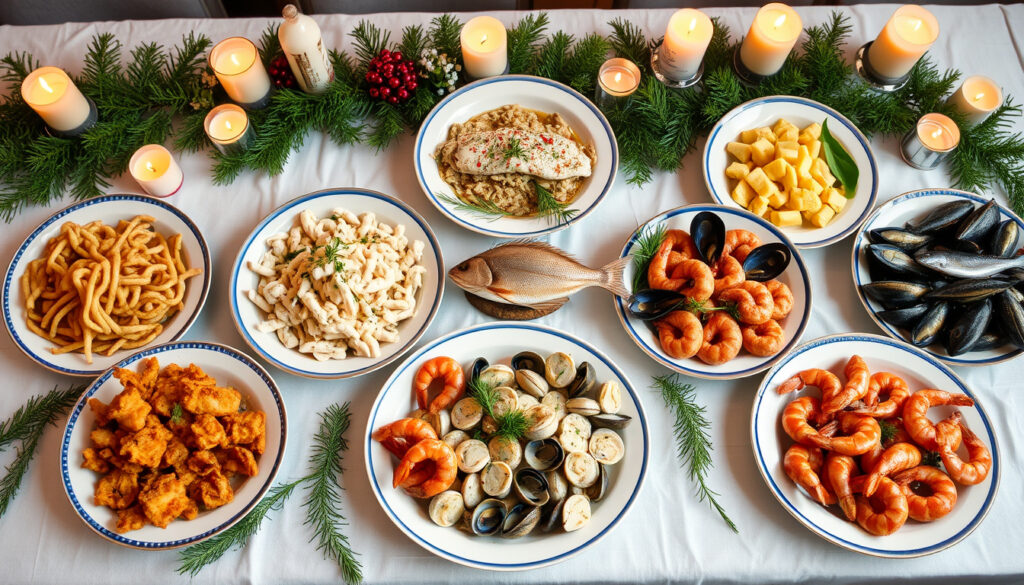
Feast of the Seven Fishes: Traditions, Menu & Meaning
Every December 24th, millions of Italian-American families crowd around tables heavy with seafood—platters of baccalà, bowls of clam sauce, crisp fried calamari. This is the Feast of the Seven Fishes, a Christmas Eve tradition that has become a defining part of Italian-American culinary identity. Yet surprisingly, this elaborate feast is more a product of the New World than the Old, a story of how an old Catholic abstinence practice transformed across the Atlantic.
Number of fish dishes in the feast: 7 ·
Date observed: December 24 (Christmas Eve) ·
Traditional Italian name: La Vigilia (The Vigil) ·
Primary cultural group: Italian-Americans
Quick snapshot
- An Italian-American Christmas Eve seafood meal (Encyclopaedia Britannica)
- No fixed canonical list of seven fish exists across families (Serious Eats)
- The exact origin of the “seven” number is debated—some say seven sacraments, others seven days, or the seven churches visited in Rome (The Fisherman)
- Whether the tradition was widely practiced in Italy before emigration remains uncertain (Eataly)
- Some accounts date the tradition to the late 1800s while others say early 1900s (Tri-County Independent)
- Modern feast emerged among Italian-American families in the early 1900s (National Geographic)
- Modern adaptations reflect local fish availability and family preference (Consumer Reports)
Eight quick facts capture the essentials of this evolving tradition.
| Label | Value |
|---|---|
| Tradition Name | La Vigilia (The Vigil) |
| Date | December 24 |
| Origin | Southern Italy / Italian-American immigration |
| Number of Fish Dishes | 7 (symbolic) |
| Catholic Significance | Abstinence from meat on the vigil of Christmas |
| Commonly Used Fish | Baccalà, eel, calamari, clams, mussels, shrimp, smelt |
| Typical Dessert | Panettone or Struffoli |
| Primary Observance | Italian-American communities in the United States |
What are the 7 traditional fishes Christmas Eve Italian?
When people ask about the seven fishes, they often expect a fixed list. The truth, according to Serious Eats (culinary resource), is that the Feast of the Seven Fishes is not universally tied to exactly seven separate fish species in every household. Families vary—some serve seven courses, others twelve, others thirteen, and still others simply serve several seafood dishes without a fixed count.
Common fish species in the feast
- Baccalà (salt cod), often in fritters or salad
- Eel, particularly in Southern Italian preparations
- Calamari, typically fried or in a tomato sauce
- Clams and mussels, frequently in pasta sauces
- Shrimp, roasted or in cocktails
- Smelt, a small fish popular with Italian-American cooks
- Sardines and other whole fish, depending on regional availability
Why these seven are chosen
The number seven carries symbolic weight in Catholic tradition. The Consumer Reports (independent testing and research organization) notes that a common feature is the inclusion of an odd number of fish dishes, often said to be for good luck.
Regional variations in Italy vs. Italian-America
According to Eataly (Italian food market and cultural authority), some families serve seven seafood dishes while others serve one or two kinds of fish prepared in seven different ways. Regional Italian Christmas Eve meals vary dramatically, with Piemonte, Roma, and Sardegna each having different holiday foods.
The pattern here is one of adaptation rather than preservation: the feast in America became a grand culinary spectacle, while in Italy the vigil remained a more modest, regionally varied affair.
Is 7 fishes a Catholic thing?
Yes, the tradition stems from the Roman Catholic practice of abstaining from meat before Christmas, a day of vigil. As Encyclopaedia Britannica (reference authority) explains, the feast is commonly associated with this Catholic abstinence practice.
Catholic practice of abstinence on Christmas Eve
- Church law historically required abstaining from meat on vigils
- Fish replaced meat as the central protein
- The vigil (La Vigilia) precedes the Christmas feast
The vigil (La Vigilia) and its religious meaning
In Southern Italy, seafood was abundant and relatively cheap, which made fish the natural choice for this meatless meal, according to Encyclopaedia Britannica (reference authority). The meal is often linked to La Vigilia, the Christmas Eve vigil meal in Italian tradition, as noted by the Portland Press Herald (Maine regional newspaper).
How the number seven ties to Catholic theology
The number seven has deep biblical symbolism, according to The Fisherman (fishing industry publication), including references to the seven sacraments, seven sins, and the seven days of creation.
While the seven-fish tradition has Catholic roots, it’s not official church doctrine. Italian-American families made it their own, layering biblical symbolism onto a practical meatless meal.
The implication: the feast is a cultural interpretation of religious practice, not a church mandate. It lives in the space where faith meets family tradition.
What is a typical menu for Feast of the Seven Fishes?
Menus vary by family, but the structure is consistent: multiple seafood courses with meat strictly avoided. Tasting Table (food media outlet) offers an example including spaghetti with clams and green olives, cod fritters, squid with chickpeas, roasted shrimp, sardine tartine, roasted red snapper, and fennel salad with anchovy vinaigrette.
Starter courses: seafood salads and appetizers
- Baccalà fritters or salad
- Seafood salad with shrimp and squid
- Clams or mussels in white wine sauce
- Smelt or sardines, fried or pickled
Main courses: baked fish, fried calamari, pasta with shellfish
According to The Delicious Life (recipe and culture blog), a traditional American menu includes salt cod, sardines, pasta with seafood, shellfish, and whole fish. The feast is often served family-style, with dishes arriving throughout the evening.
Dessert and drinks to complete the meal
The meal typically concludes with panettone or struffoli—Italian Christmas desserts—and is accompanied by red and white wines, as Food Network (culinary television network) describes in its overview of the celebration.
What makes the feast memorable isn’t the exact fish on any platter—it’s the generational rhythm of preparing and sharing the meal, a tradition Food Network (culinary television network) notes is passed down through families.
The catch: there’s no single “authentic” menu. The feast is a framework, not a recipe box.
How do you say 7 fishes in Italian?
“Seven fishes” translates as “sette pesci” in Italian—but here’s the surprise: Italians rarely use this phrase. The Feast of the Seven Fishes is an English-language term, as Italian food experts at Eataly (Italian food market) indicate.
Literal translation: “sette pesci”
- Sette = seven
- Pesci = fish
- Combined: sette pesci
Cultural context: Italians rarely use the phrase “Feast of the Seven Fishes”
In Italy, the Christmas Eve meal is simply called “La Vigilia” or “Cena della Vigilia” (Vigil dinner), according to the Portland Press Herald (Maine regional newspaper). The term “Feast of the Seven Fishes” is a distinctly Italian-American creation.
Common Italian expressions for Christmas Eve seafood meal
Italians might say “cenone della Vigilia” (big dinner of the vigil) or “pesce della Vigilia” (vigil fish) to describe the meal.
The trade-off is clear: Italian-Americans invented a name that captures the abundance of the feast, while Italians themselves kept the simpler, religiously focused title.
What do real Italians eat on Christmas Eve?
Italian Christmas Eve dinners vary dramatically by region, and seafood is common but not universal. Eataly (Italian food market) cites Piemonte, Roma, and Sardegna as regions with different holiday foods, showing that no single tradition dominates the peninsula.
Regional Italian Christmas Eve traditions
- Southern Italy (Campania, Sicily) has strong seafood traditions
- Northern regions may serve fewer fish dishes
- Central Italy balances fish with other local specialties
Differences between Southern and Northern Italy
Southern Italy’s abundant, affordable seafood made fish the natural Christmas Eve choice, as Encyclopaedia Britannica (reference authority) notes. Coastal areas simply had more access to fresh fish than inland regions.
Is the seven-fish feast common in Italy today?
The specific “seven fishes” concept is largely an Italian-American invention, according to National Geographic (science and history publication), which describes the modern feast as emerging among Italian-American families in the early 1900s.
What began as a practical, meatless vigil meal in Italy grew into a spectacular New World feast. Italian-American families took a humble tradition and made it a centerpiece of Christmas identity.
The pattern: the feast’s very popularity in America is what separated it from its Italian origins.
Clarity: What’s certain and what’s not
Confirmed facts
- The Feast of the Seven Fishes is an Italian-American Christmas Eve meal centered on seafood (Encyclopaedia Britannica)
- The number seven has Catholic symbolic associations, including sacraments and creation days (The Fisherman)
- Common fish include baccalà, eel, calamari, clams, mussels, shrimp, and smelt (Tasting Table)
- The tradition is known as La Vigilia in Italian (Portland Press Herald)
What’s unclear
- The exact origin of the “seven” number is debated—some say seven sacraments, others seven days, or the seven churches visited in Rome
- Whether the tradition was widely practiced in Italy before emigration remains uncertain
- The specific list of seven fishes varies by family; there’s no official canonical list (Serious Eats)
The tension between these certainties and unknowns reflects the evolving nature of the tradition.
Perspectives on the tradition
The feast is more about family tradition than a fixed menu. What matters is the gathering, not the exact count of fish on the table.
— Michele Scicolone, Italian-American cookbook author
Italian immigrants adapted the vigil to New World ingredients. The abundance of American fish markets made the feast both practical and spectacular.
— Alberto Capatti, food historian
The seven-fish custom is a folk tradition, not church doctrine. It emerged from Catholic abstinence practices but was shaped by culture, not canon law.
— Catholic theologian
For Italian-American families, the Feast of the Seven Fishes means more than a good meal—it’s a bridge to heritage. On Christmas Eve, tables groan under platters of seafood, and the stories of grandparents who first cooked these dishes fill the room.
For anyone new to the tradition, the choice is clear: embrace the flexibility, pick the fish that speaks to your market and your family. For Italian-Americans keeping the feast alive, the implication is equally clear: preserve the spirit, not the exact count, and let the tradition keep evolving—or risk it hardening into something unrecognizable from the warm, generous meal it’s meant to be.
post-gazette.com, thedeliciouslife.com, fisheries.noaa.gov, en.wikipedia.org, tastingtable.com, topanganewtimes.com
Frequently asked questions
What fish do Italians eat the most?
Across Italy, the most-consumed fish include anchovies, sardines, cod (fresh and salt), and various shellfish, though regional preferences vary widely.
Where to watch Feast of the Seven Fishes?
The phrase “Feast of the Seven Fishes” may refer to both the culinary tradition and the 2018 independent film of that name, which is available on streaming platforms including Hulu and Prime Video.
What do Italians drink on Christmas Day?
Italians commonly enjoy sparkling wines like Prosecco, along with red wines such as Chianti or Barolo, and finish with digestifs like limoncello or grappa.
What is a traditional Italian Christmas dessert?
Panettone, a sweet bread with candied fruit and raisins, is the most iconic Italian Christmas dessert. Struffoli, honey-coated fried dough balls, are especially popular in Southern Italy.
What is Italy’s most famous drink?
Wine is Italy’s most famous beverage, particularly in global recognition. Coffee, especially espresso, is also deeply central to Italian culture.
What do Italians say instead of “merry Christmas”?
Italians say “Buon Natale” for “Merry Christmas,” and “Buone Feste” as a more general holiday greeting.
More related posts
 Blue Jays vs Orioles: Predictions, Stats & Head-to-Head History
 How to Clear Cache on Any Device: Android, iPhone, Brow er
 James L. Avery: Cause of Death and Biography
 Delivery Restaurants Near Me – DoorDash vs Uber Eats vs Grubhub
 Copy and Paste Fonts: Guide to Legality & Popular Fonts
 How Old Is the Sun? Age, Lifespan, and Comparison to Earth
 Meta Stock Price Today: Live META Quote, News & Forecast
 Black Rabbit Netflix Miniseries: Cast, Plot, Reviews & More